Ham, pork, pickles and pride
A love letter to the Cuban diaspora hidden between two slices of bread
June 19, 2026 | story, photos and illustrations by Delia Rose Sauer
This story is from Atrium’s Spring 2026 magazine, which released April 2026.
The assembly line of latex-gloved hands crammed into the small kitchen is efficient. On one end, hot oil crackles. Pale croquetas, breaded and ready to be browned, descend inside a metal basket, triggering an explosion of glistening bubbles.
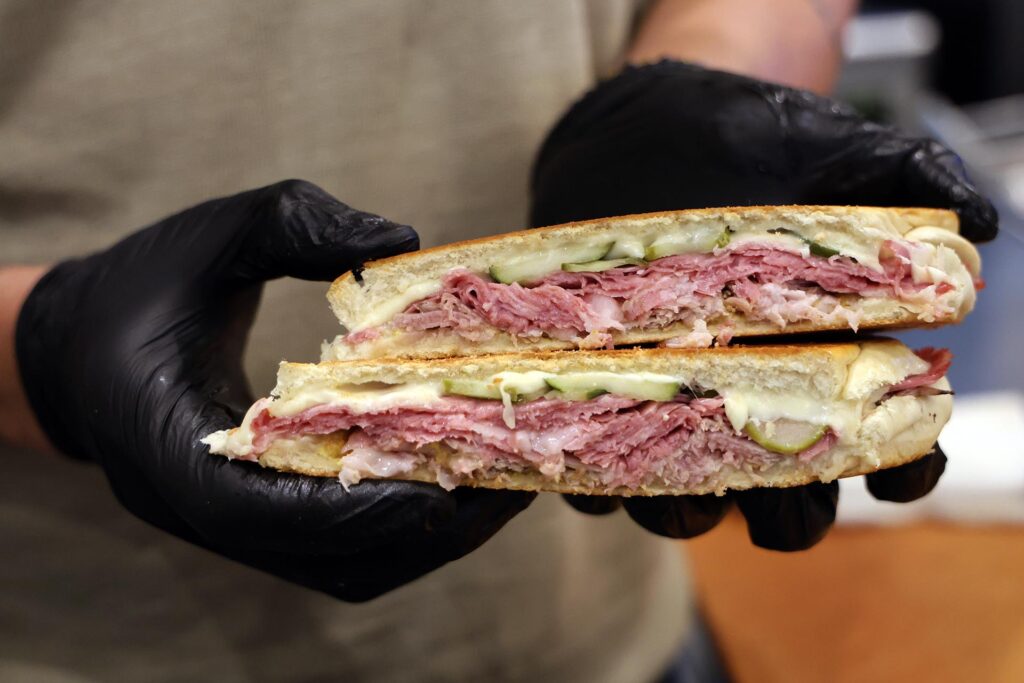
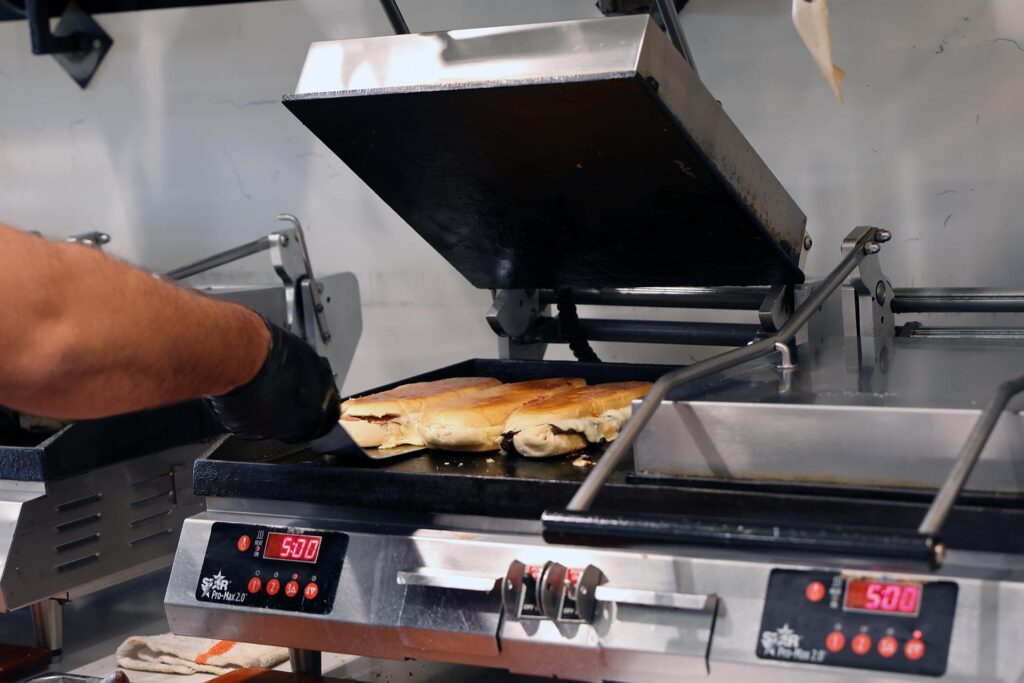
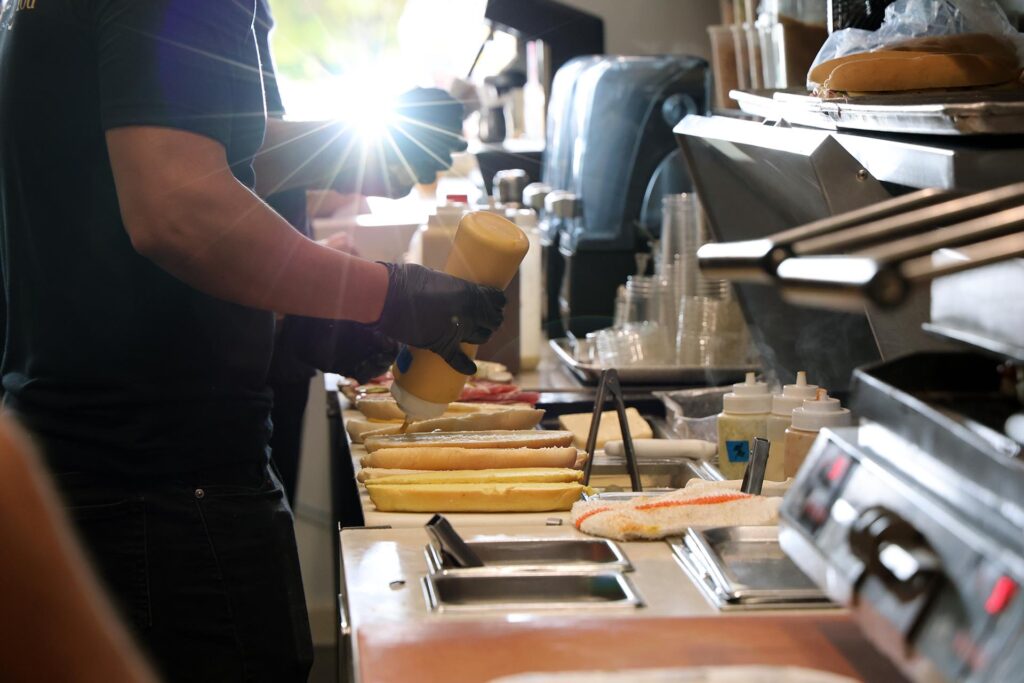
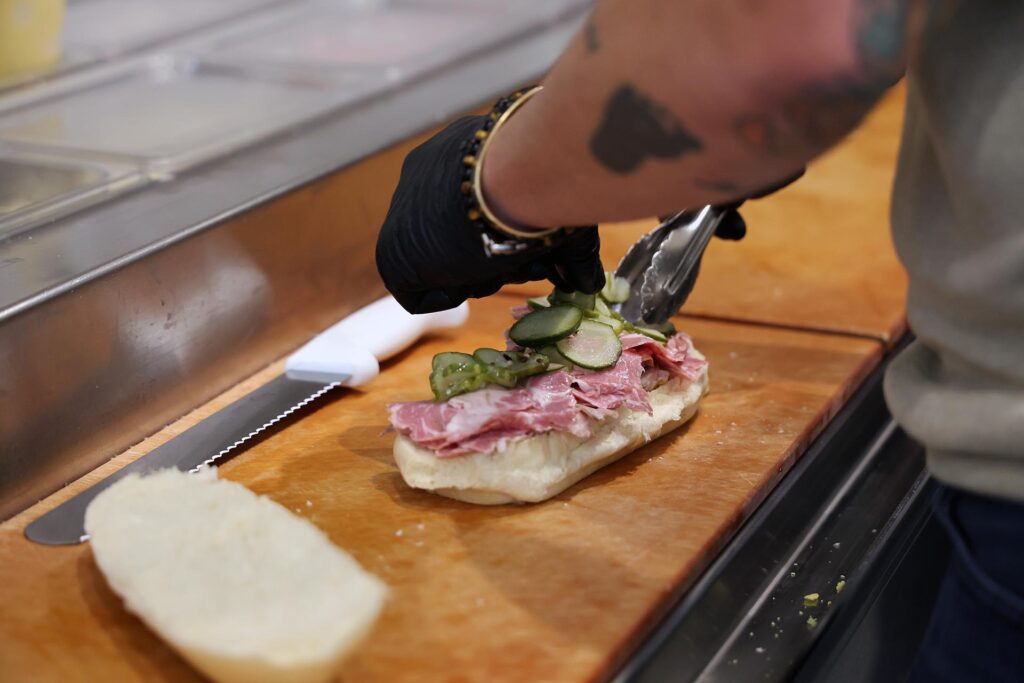
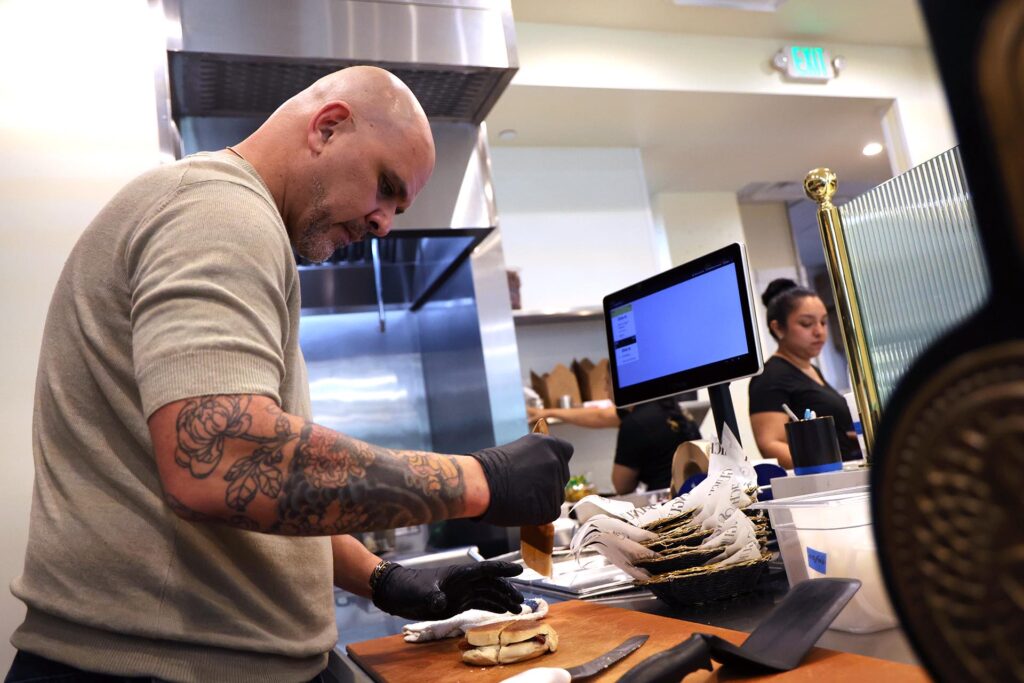
On the other end of the line, where the humidity from the open window, or ventana, blends with the heat of the “planchas,” a flat-top griddle with metal plates, workers paint layers of lard on top of Cuban bread. At the next station, they stack thinly sliced lechon, or pork, and ham. They arrange the pickles over the baby-blanket-pink meat. Finally, they plop two slices of Swiss cheese before gluing the sandwich closed with a heaping spread of house-made mustard. Someone else snatches the sandwich and presses it between the heavy plancha plates. Press. Slice (diagonally –– the only acceptable way). Wrap. Serve.
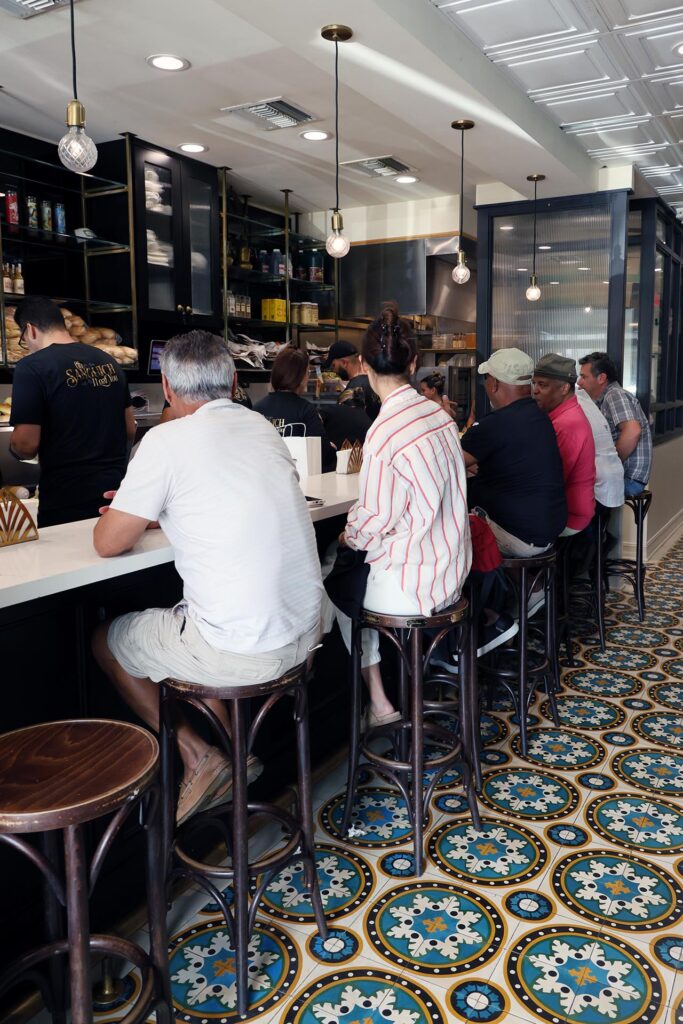
At Sanguich, a Cuban sandwich lunch counter in Little Havana, the assembly line operates from 10 a.m. to 6 p.m. Inside, the bar seats are always full as customers chat with the women in la ventanita, stir cafecitos and tear into their sandwiches. Outside, customers in a rush wind through the small parking lot with squinting eyes as they avoid Miami’s blaring sun. No one needs a menu if they aren’t tourists; it isn’t the first time they’ve sat on Sanguich’s wooden stools.
In Miami, the Cuban sandwich is what pizza is to New York City. A time capsule of some of the most iconic Cuban flavors, the sandwich acts as a quick, savory-but-sweet bite that offers a taste of home for multiple generations of Cubans. As Miami continues to transform into a bustling, multicultural hub, the sandwich remains an artifact of the Cuban diaspora, evolving alongside Miami’s cultural landscape.
The meaning of the Cuban sandwich is defined by experience, one to be explored. From the older generations of Cubans who remember “mixtos” made with thin bread and whatever meats they preferred from the island, to the newer generations of Latin American immigrants exploring the time capsule that is Miami’s Cuban culture, some treat the sandwich as something that can never be altered, only perfected. But for others, it’s a conduit for a greater identity, one that exists on the hyphen in front of the word American.
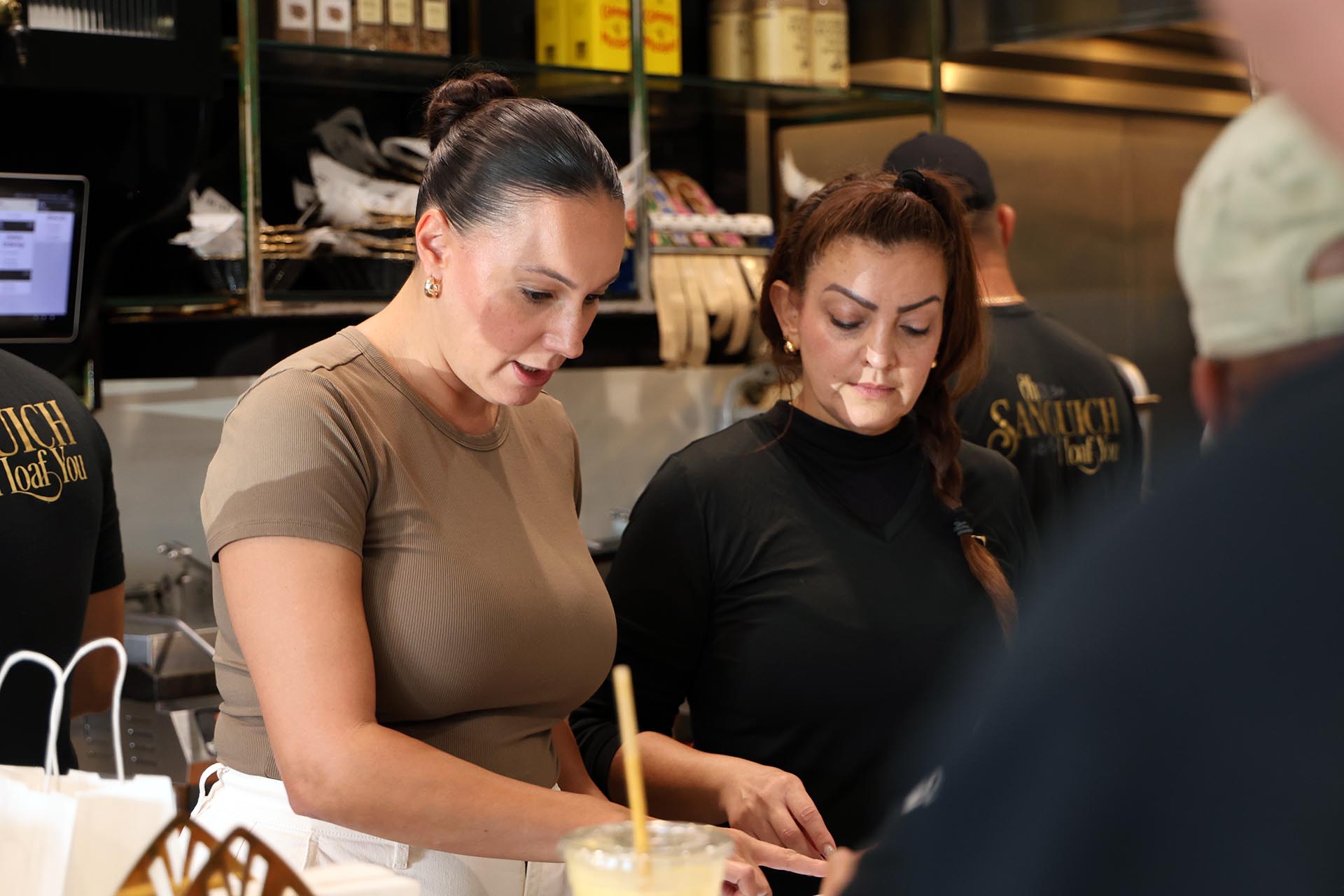
Daniel Figueredo, the 49-year-old co-founder of Sanguich, works behind the line whenever he visits one of his four locations –– soon to be five. Behind his thick-framed glasses, he can’t enter the cubby of a kitchen at the Little Havana location without greeting the shop’s regulars. He leans down, hunching to hug a familiar face. He asks about the food. He offers a cafecito or croqueta on the house, and his customers try to refuse. It’s a common routine, Daniel says. But nothing can beat Cuban hospitality, especially when it comes from the desperate need to feed your neighbor. The regular eventually admits defeat. Daniel rushes to the kitchen to fulfill the order.
Daniel can’t get to work without also greeting every employee. He claps the plancha operator on the back, a bright smile stretched across his face. He shuffles toward the dish pit, and after dipping his arms elbow-deep in muddied water, a woman approaches from behind.
“Andrea!” He immediately brightens. He hesitates for a moment, not wanting to dirty her uniform, and decides to hug her from the side, the Sanguich logo wrinkling as they draw each other close. “¿Cómo estas?”
Daniel recognizes faces like a game of Guess Who. As he delivers sandwiches, he recalls each name, something he believes is a necessary connection in a city like Miami. The bond between owner and customer is less common thanks to the yearly influx of snowbirds, tourists and families who decide to make the move to Miami, a horde of unfamiliar faces that have begun replacing longtime locals and natives, who are often pushed out of the city due to increasing prices and too little space.
He flies from table to table, end to end of the restaurant, built with his own hands with help from generations before him. As he prepares to open his fifth location in Aventura, he’s as busy as ever as he tries to keep the humble sandwich alive for newer generations who don’t understand the significance of the ham, pork, pickles and cheese.
–––
Sanguich was an idea born on a Friday in 2006. Daniel opened his front door to welcome his friends for their weekly cigar club, which they called “The Bastards.” The smell of tobacco filled his home as his friends sliced cigar tips and lit the leafy stubs. Beads of condensation dripped onto the shared table, the ice in their glasses of scotch slowly melting as they smoked and ate and laughed into the early hours of the morning.
Daniel took pride in serving his friends sandwiches. Sometimes it was a grilled cheese, other times it was a Cubano. Sober or drunk, they’d insist on one thing: He had to break into the food business.
“That doesn’t make sense,” he told them. That didn’t stop him from scribbling the plans, trademarking a sandwich shop idea under its original name, Meltwich, where he would sell grilled cheeses. Nearly a decade later, he met his wife, Rosa Romero, through a friend. She was an executive paralegal, and after they hit it off, Daniel shared his idea.
“That’s a really cool idea,” Rosa said. “But I think it should be Cuban sandwiches.”
He agreed. But the concept stayed in limbo. They’d draft plans and brainstorm, but Daniel’s position as a director of business development for a manufacturing company based in Colorado and Rosa’s paralegal work came first. The idea of Meltwich, which would later become Sanguich, collected dust until 2015, when Rosa gave birth to their first daughter, London. In a moment where Daniel was holding his daughter close, bouncing her in his arms, he was suddenly compelled to dial Rosa. He waited as it rang, all while looking down at his future, his family. Rosa picked up.
“Hey,” Daniel began. “Remember that Cuban sandwich shop we wanted to start?”
“Yeah,” Rosa replied.
“Well, I quit my job,” he said. “It starts today.”
“Great,” Rosa responded. “What’s for dinner?”
The two of them got to work. Sanguich began as a food truck in 2017, where the couple sold Cubanos at the Coconut Grove Arts Festival. That same year, they won the Calle Ocho Cubano Wars, an event where chefs compete to make the best Cuban sandwich. The first permanent location, the shop in Little Havana, opened in 2018.
Business moved quickly. Sanguich’s promise was to focus on producing every component of the sandwich in-house. From the mojo to the pickles to the mustard, all were products of Daniel and Rosa’s team. But by prioritizing a more artisanal interpretation of the sandwich, the restaurant sacrificed speed and cost. Making the sandwich was slow and expensive.
“It goes against everything that we know that a Cuban sandwich should be,” Daniel says. Instead, the sandwich needed to be cheap and fast, mirroring its roots in Cuba, where the sandwich was a quick meal for factory workers.
The next decision was to industrialize the humble process of creating a Cuban sandwich.
To do so, Sanguich capitalized on its loyal consumer base, both tourists and locals alike. When tourists began to outnumber locals, the couple expanded their locations into less touristy areas.
The closest thing Sanguich has to a headquarters is its location in Little Haiti, where the ventanita is misspelled and reads “La Ventnita de los Parados.” Inside the white, concrete warehouse is where the sausage –– really the ham and pork –– gets made.
Daniel is protective of his production line. Throughout the building, as employees slice bread and pork, reggaeton and dembow blast on the speakers. Everyone communicates in an unpredictable pattern of English that jumps to Spanish or the other way around. He steers the helm, pacing from the entrance of his barn-door office to the freezer where the ham marinade and mojo steep.
He describes it as a scaled process of marinating, injecting, slicing and serving everything by hand. The hands are just helped by machines meant to streamline the process. When too many customers lined up to get a taste of one of Miami’s best-rated Cuban sandwiches, Daniel patented “La Plancha,” a black and gold, wide sandwich plancha with a rolling mechanism to press sandwiches down. With it, they sold 1,300 sandwiches in a day.
“Recipes are the same, process is the same. The machines help us expedite,” he says.
And it worked. Sanguich holds a spot on the Michelin Guide as a Bib Gourmand, an award given to affordable restaurants that serve high-quality food. The South Florida Sun Sentinel, Miami Herald and Bon Appétit have listed it as some of the best Cubanos Miami has to offer. By transforming the familiar traditional process of throwing the sandwich together, Sanguich did what some say Cubans have mastered: It adapted. The restaurant didn’t have the luxury of time. To keep up with locals and tourists, Daniel and Rosa had to adjust tradition. All that matters is that the flavor and history are preserved.
Daniel has seen his sandwich bring older generations, those who left their home behind, back to Cuba. He recalls greeting a customer, an elderly Cuban gentleman. He drank in the blue, black and golden Cuban tiles, decorative squares of cement with vibrant colors and mosaic patterns mirroring designs native to Spain, the shop’s custom sconces and the familiar smell of garlic and coffee beans. “This reminds me of Cuba,” he told Daniel.
Daniel smiled back.
With every location, he wants Sanguich to be a place where a millionaire and a retiree can share a cafecito and appreciate Cuba’s roots. They don’t have to be Cuban themselves anymore.
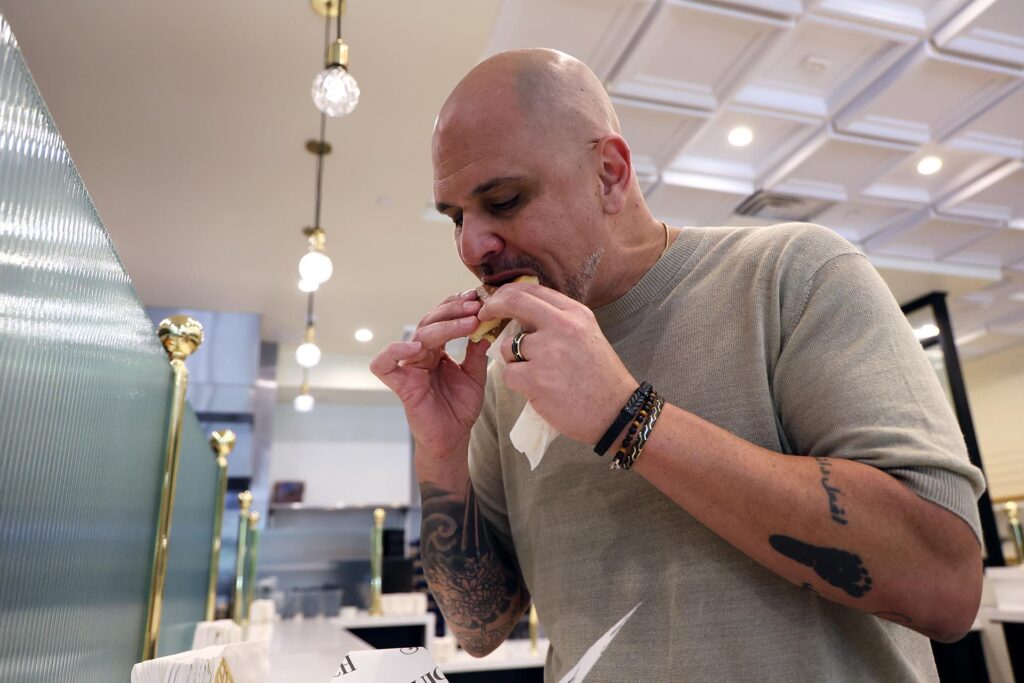
“Miami is no longer Cuban,” Daniel admits. “Miami’s international … My job now is to be Cuban American and be an owner of a Cuban sandwich shop. My job is to protect that at all costs.”
–––
For many Cubans and Cuban Americans, the Cuban sandwich is a common indulgence. For me, it was a concept, an idea of a heavenly combination of flavors I’ll never fully understand. My American-born self developed something that would never exist in Cuba, or so my grandmother likes to tell me: allergies. Nine pages of them to be exact, including dairy, eggs, nuts, soy and the occasional oddball, mango, chickpeas and mustard. The cultural cornerstone, the Cuban culinary classic, was always in sight but out of reach.
Visiting the local ventanita is a relatable memory for any Cuban raised in Miami. As a child, my mom held me close as we approached the ventanita at La Caretta, a famous Cuban restaurant empire in South Florida. Her hand reached down to shield me from cigarette smoke and the soaring spit of boisterous elderly Cuban men as they cracked raunchy jokes on a Saturday morning. I didn’t understand what they meant, and my mom refused to explain.
My mom would force me to accompany her to the ventanita to practice my mumbled Spanish, where I would butcher my pronunciation by “eating” any s or d sounds. Skipping those letters is a recognizable trait of the Cuban accent. Despite my mom having Vivaporu at arm’s reach and spending two days making black beans at my request, she didn’t want me sounding Cuban. I was born in Miami –– in America –– so I must speak Spanish neutrally.
I never understood her, but my mother knew best. So I obliged.
At the ventanita, I balanced on my sparkling Twinkle Toes shoes as I peered into another world. The women inside chattered like a flock of birds, their red lipstick and thick eyeliner always perfect despite spending hours packed in a heated pocket that smelled of butter and coffee. They clanked the espresso machine and pressed on the oiled plancha, crushing slices of Cuban bread until they bubbled with crisp, golden edges.
In a rare occurrence, my mom ordered a Cuban sandwich with a café con leche. The ventanita lady, with her wrinkled blue eyeshadow and gray smile, shot her head toward me, her brown eyes trying to predict my order.

I beat her to it. “Una tostada sin mantequilla, por favor,” I told her.
She made a face, a contorted expression that confused me. “¿Sin mantequilla?”
I nodded. She laughed, and my mom was not pleased. “Ella es alergica,” my mom said.
The woman waved a hand, grabbing a piece of parchment paper to protect my slice of Cuban bread from the dangers of a buttered plancha.
We collected our order, returned to the parking lot, and I entered the backseat of my mother’s black SUV. I squirmed, as 8-year-olds often do, as the hot leather pressed against my exposed skin, regretting my decision to wear shorts inside a dark car during a Miami summer.
I watched as my mom tore open her sandwich, unsatisfied. She split it open, and the smell of sweet ham and citrus attacked my nose. It was too early to smell anything other than coffee.
“They put too much ham,” my mom complained, showing me the cross-section of her sandwich in the rearview mirror.
I nodded and agreed, as if I knew any better.
“There’s not enough pickles!” She added. “This isn’t what it’s supposed to be.”
I nodded again. She took a bite anyway.
–––
The Cuban sandwich is often a connection to a memory. A memory of sun-kissed skin, ocean breezes and the close community they left behind. For others, it’s a shared meal with family long gone.
Bárbara Cruz was 5 years old when she arrived in the United States from Cuba. Processed in the Freedom Tower and relocated to California, she was a stranger in a strange land. She didn’t know English. She was perplexed by the culture, confused as to why teachers thought she was drinking beer when her mother packed a bottle of Malta with her lunch.
She remembers cracking her eyes open on a Saturday morning after moving to Miami before starting high school. She rose to the melody of her father’s puttering around the house, hands itching to find something to fix. He got her out of bed, and their routine began. Bárbara fixed herself up to join her father at the American mom-and-pop hardware store –– Lowes and Home Depot weren’t a thing yet, she recalled.
“Come with me,” he’d say in Spanish. “So you can help translate.”
But he couldn’t run his errand without stopping by a ventanita. “¿Qué tu quieres?” The lady asked with the fondness of a mother.
Bárbara pursed her lips; her father had already ordered a colada, a small stack of plastic cups at the ready. “Un cubano,” she said.
It was a rare occasion. She knew she’d receive an earful from her mother, who’d get frustrated every time her father allowed her to sneak a Cuban sandwich during their visits. She always said it would ruin her appetite for lunch.
With a café con leche in hand to dip her sandwich in, she trailed at her father’s hips as he strolled into the hardware store. He’d place the nuclear-hot styrofoam cup down on the counter, the American owners watching from behind the register. They’d gather, and despite his broken English, coffee was a universal language.
His calloused hands poured the steaming espresso into three little cups, and he slid them toward the owners. And they’d drink together.
Bárbara understands the universal language of food. In Miami, where Venezuelans and Colombians have made the arepa mainstream and thousands of other immigrants have brought their own cuisines, the Cuban sandwich evolves to welcome others into a home, just as her father did.
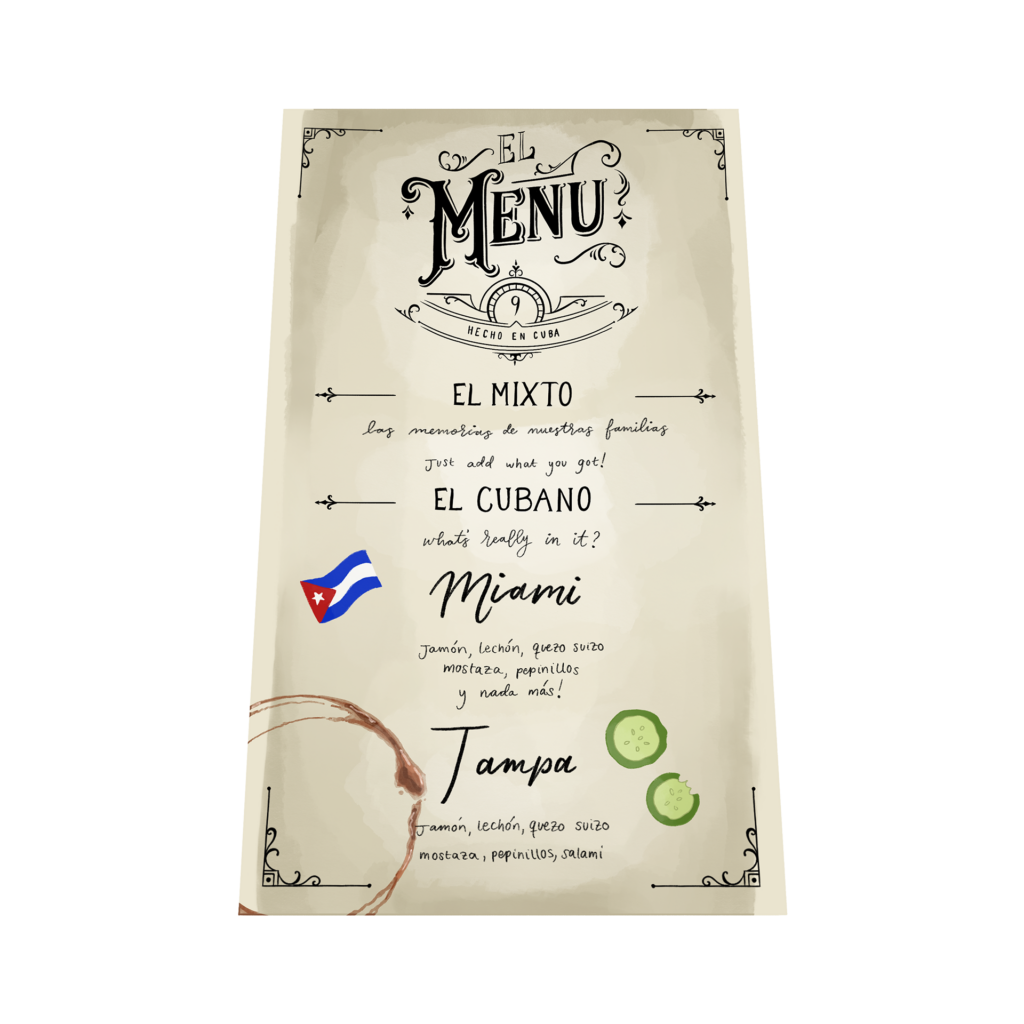
Bárbara, now a social science education professor at the University of South Florida, co-authored a book cataloguing the history of the Cuban sandwich called “The Cuban Sandwich: A History in Layers.” Most people believe the sandwich found its start in Tampa or Miami, depending on who you ask. The rivalry between the two cities comes from what actually makes up the sandwich.
The Miami sandwich is what Sanguich defines as the classic: Cuban bread, ham, mojo pork, Swiss cheese, pickles and mustard. In Tampa, there’s one extra ingredient: salami. Yet, the Cuban sandwich is not a product of either city. It truly began in Cuba under a different name, with undefined boundaries of what could be inside — a “mixto.”
Sandwich vendors would roam the streets outside of Cuban factories, mirroring the sales pitch of a classic “manisero,” a peanut salesman. With no official recorded history, historians theorize that workers would purchase quick sandwiches from salesmen or wander into shops and ask for whatever was fresh.
It wasn’t until Cubans crossed the Straits of Florida, bringing along their lunchtime traditions, that a proper Cubano began to appear in the United States during the early 1900s. But as Tampa and Miami argue as to who can claim the modern-day Cubano, Bárbara has seen the sandwich pop up in places beyond Florida.
While working on the book, Bárbara found herself drowning in research. She traveled up to New York, where, unrelated to her work, the New York Medical Society caught her interest. She discovered boxes and boxes of papers and notes from a female professor of medicine in New York who had the interesting habit of pocketing restaurant menus. Inside, she struck gold. The professor had swiped a cafeteria menu from the U.S. Capitol Building, which Bárbara dated to before 1921, that listed a Cuban sandwich for 15 cents. The ingredients inside were unknown.
It’s more than a Cubano, Bárbara believes. From its birth in Cuba to its widespread fame across the country, the sandwich has matched the planet’s ever-evolving tastes. She knows of a South Korean restaurant owner based in Seoul who created a Cubano with kimchi. She recalls eating a sandwich that was basically a classic modified with mortadella.
The sandwich is no longer for native Cubans; on the island today, none of the necessary ingredients are available to normal people. It’s no longer exclusive to Cuban migrants either, Bárbara says. The sandwich belongs to anyone who can recognize the comfort of a good meal.
“The Cuban sandwich seems to elicit a very emotional response from a lot of people,” Bárbara says. “This could be because of who you ate it with, what was happening in your life, when you ate it, where it was procured.”
Carlos Frías, a freelance food writer based in Miami, is deeply connected to the Cuban sandwich. He was raised in Broward County, where he spent his days in the strip mall where his parents owned a jewelry shop. At the end of the plaza was a classic Cuban bakery.
“Go down to the bakery and order a Cuban sandwich,” his father often asked him. “Make sure that they put plenty of pierna in it.”
Knowing the passion behind the sandwich, when he broke into the food reporting scene, he was wary of writing about the famous dish. He finds debates on its origins tiresome, but in his work, he emphasizes one thing: “It codifies, in a very physical and literal way, the parts of Cuban culture,” he says.
Carlos has found himself sitting down on counters and tables across Miami, ordering the same item: a Cuban sandwich. It encompassed his life. In his quest to review the best sandwiches of the city, he befriended the owner of Versailles, Felipe Valls Jr., arguably the most famous Cuban restaurant in the United States.
A couple of years ago, he called Valls with a request. He was done pressing one sandwich at a time, and by the time he was ready to eat, his wife and three daughters’ dishes were already clean. He needed to buy a commercial plancha.
“For what?” Valls asked over the phone.
“For my house,” Carlos said.
He was away, somewhere in the Bahamas or Caribbean. Carlos didn’t recall. “I’ll be back in two weeks, and then I’ll look into it,” Valls replied.
Two weeks later, he received a voicemail.
“I’m eating a sandwich that I just made on your press,” Valls said. “Come get it.”
Now, Carlos is a proud owner of a commercial plancha from Versailles, for which he searched for custom metal plates in Hialeah, with a golden name tag, “La Planchita.” He’s made so many Cuban sandwiches at home, he’s convinced his wife is sick of it.
In Latin Cafe 2000, a Cuban chain restaurant in Miami, he orders his usual, a Cubano. As the waitress brings it to his table, asking if he needed anything else, he snaps a picture of the sandwich he’s eaten too many times to count. It’s cut vertically. Not diagonally. He doesn’t seem to care.
He deems the sandwich a love letter to all generations of Cubans. He doesn’t care if the sandwich has salami or not. All that matters is that it represents the familiar flavors that make any Cuban, and any tourist, melt into the next bite. And that it doesn’t have mayo. Or the ridged marks of a panini press. Besides that, most ingredients inside a Cuban sandwich are fair game.
He compares the sandwich to the Beatles. People can experiment, come up with new risks. At the end of the day, you resort to the classic. As Miami shifts away from being predominantly Cuban, he’s witnessed an overlap between cultures fighting for space in the city.
Now, there’s a Florida food culture, where Cubano variations reflect a new clientele. Tinta y Café, a Miami coffee house, serves a sandwich with French mustard and mortadella on a baguette, not Cuban bread. Empanada Harry’s Bakery and Cafe, also based in Miami, offers a Cuban sandwich empanada. In Jacksonville, an Italian restaurant named after the Spanish painter Pablo Picasso sells a classic Miami Cuban sandwich in a city where around 1% of the population is Cuban.
–––
Inside Sanguich’s Coral Gables location, my mom sips from a tile-white cafecito cup. She offers me a drink. I’ll never decline free coffee. Rosa scurries throughout the restaurant, greeting each table with a grin. She occupies herself by exchanging stories with customers and asking about regulars and their children.
“Are you nervous?” my mom asks me.
“Nah,” I say. I’m ready.
A waitress places a green basket before me. “Gracias,” my mom and I say together. In a quiet jinx, I take another sip of her espresso as a tax. The branded paper crinkles as I stare down at the sandwich in front of me. Rosa promised Sanguich could make an allergy-friendly Cubano. The bread was brushed with lard, not butter. They skipped the smear of mustard and the twin slices of cheese. Between crispy golden slices of sourdough Cuban bread lies the ham, mojo pork and pickles I’ve spent my whole life hearing about.
My mom sorts through her own sandwich, showing me the cross-section in the same way she used to, no longer from the rearview mirror. “This is a good cross-section,” she says proudly. She loves seeing Cubans succeed. “And there’s no mayo.”
She’s still hung up on the one restaurant I told her about that serves a Cubano with mayo.
I laugh as I bring the sandwich to my mouth. The heat from the bread kisses my fingers, and the citrus pierces through my congested nose. Finally, after 21 years of not being able to experience one of the most quintessential Cuban foods, I get to take a bite.
And I finally understand. It clicks why my mother picks out the layers of meat in an overstuffed sandwich. It has to be perfect because the feeling of home is perfect. It connects me to her island, both familiar and unfamiliar.
The tang of the pickles cut through the savory pork and ham. The toasted bread adds texture. I didn’t know a sandwich could be that good. I was only ever used to plain white bread and a couple of slices of turkey or ham. I look over at my mom, and she can’t contain her joy. She’s just as excited as I am.
“What do you think? Is it as good as you expected?” she asks. Her voice is tense, as if she’s waiting for me to be disappointed, as if the sandwich didn’t really mean anything to me.
“Yes,” I tell her. “I love it, mama.”
