What bricks remember
Saving the Apalachicola Arsenal Powder Magazine Museum
June 5, 2026 | story by Chloe Abreu
photos by Delia Rose Sauer
This story is from Atrium’s Spring 2026 magazine, which released April 2026.
Linda Kranert remembers the gentle sound of critters scurrying off in unseen directions as she stood within the mossed-over threshold of a building all but reclaimed by nature. Faded brick arched into vaulted ceilings, interrupted by a tree surpassing its stone boundary. The light from the ceiling gap fell on the dusty ground as patches of grass twisted their way between once-impenetrable walls.
Much like the quiet city of Chattahoochee, Florida, the building was tucked away, a secret on the grounds of a hospital.
Linda, a 77-year-old museum coordinator and grant specialist, found the deteriorating building, the Apalachicola Arsenal Powder Magazine Museum, beautiful. There was an untold history in the cracked and engraved bricks.
1993
Before the arsenal became Linda’s life’s work, she lived with her husband in Tallahassee. Bored studying for an exam, Linda resorted to flipping through job listings in the office of her husband, who was an attorney for the hospital. Her fingers leafed through the pages until one stopped her.
“I could do that job,” she said aloud.
Her husband turned around. “What job?”
“Medical unit supervisor,” she answered.
Two weeks later, Linda received a phone call from the hospital for an interview for a job she never applied for. She called her husband for an explanation.
“Well, you said you wanted to do that job,” he said.
“No,” she corrected, “I said I could do that job.”
She went to the interview anyway and landed the position.
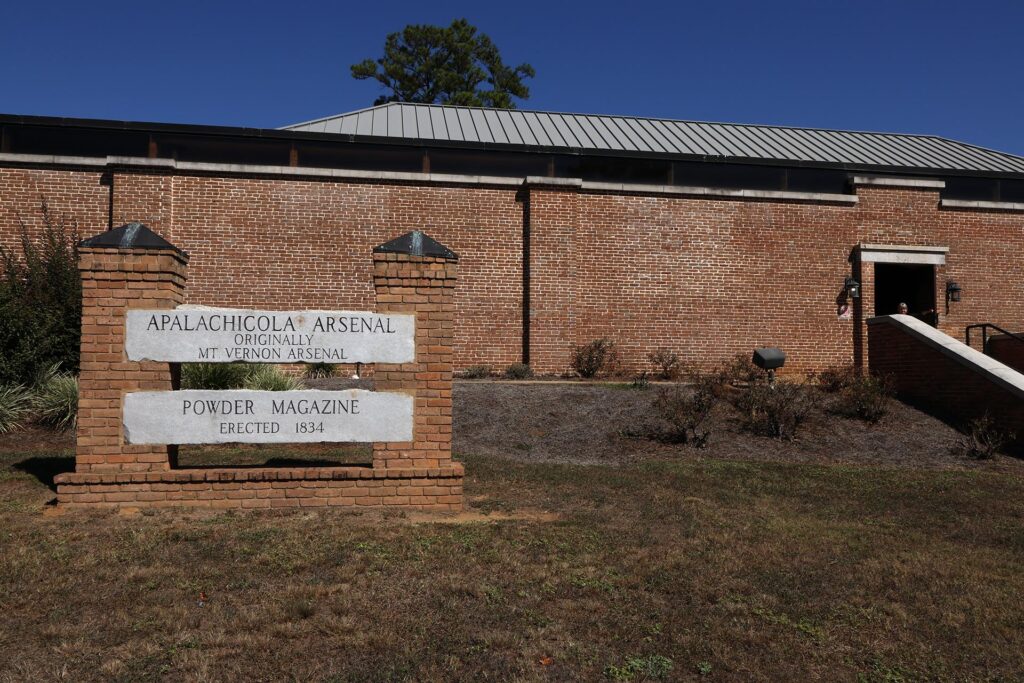
As part of her onboarding as a new employee, she was given a tour of the Florida State Hospital grounds. The image of the brick building lingered as she told her boss, Marguerite Morgan, how much she liked it.
“Don’t get used to it,” Marguerite said. “It’s going to come down soon.”
“That shouldn’t happen,” Kranert remembers thinking to herself.
She wanted to do something, but Linda didn’t have a background in historic preservation. She attended the University of Miami, where she initially majored in physical education before switching to English. She didn’t yet know the building’s connection to the Civil War or how it became part of the hospital grounds. What she did know, standing in that overgrown ruin, was that it deserved to survive.
The grounds were a time capsule, unchanged since the 19th century. Buildings at the forefront of the hospital grounds shine a stark, sanitary white, unlike the metallic window-filled monoliths of modern hospitals. But Linda was more curious about the crumbling powder magazine inside, a Civil War-era ammunition storage center, about half a mile away. Determined to save it, Linda discovered the Department of State’s Special Category Grant, a competitive grant providing state funding to support local, regional and statewide efforts in historic and archeological preservation.
Linda saw her opportunity, and something stirred inside her. “I loved history when I was a kid,” she says. “Restoring and saving history for me is one of my favorite things.”
Marguerite, Linda’s boss, remembers the early days of Linda’s restoration efforts. The push to save the powder magazine was built on paperwork, intuition and passion on Linda’s part, all of which Marguerite got to experience firsthand.
“Linda’s very persuasive,” Marguerite says. “She can get stuff out of people you wouldn’t think would give anything.”
Linda’s persuasiveness became a tool in her grantwriting, the weapon behind her restoration. Her words influenced the grantors to care about the powder magazine as much as she did. To draft a grant, Linda catalogued the building’s needs like a doctor diagnosing a patient’s symptoms. Then she worked to procure the right medicine, or the grants, to meet the building’s needs. Linda figured out what she needed to convince those who approve them. For a building like the magazine, its historical significance is a convincing factor.
Linda used a three-step routine for her research into the building’s history. Step one, she lounged in her living room, the light of her laptop illuminating her face as she typed her first question into Google. Step two, she verified each source individually.
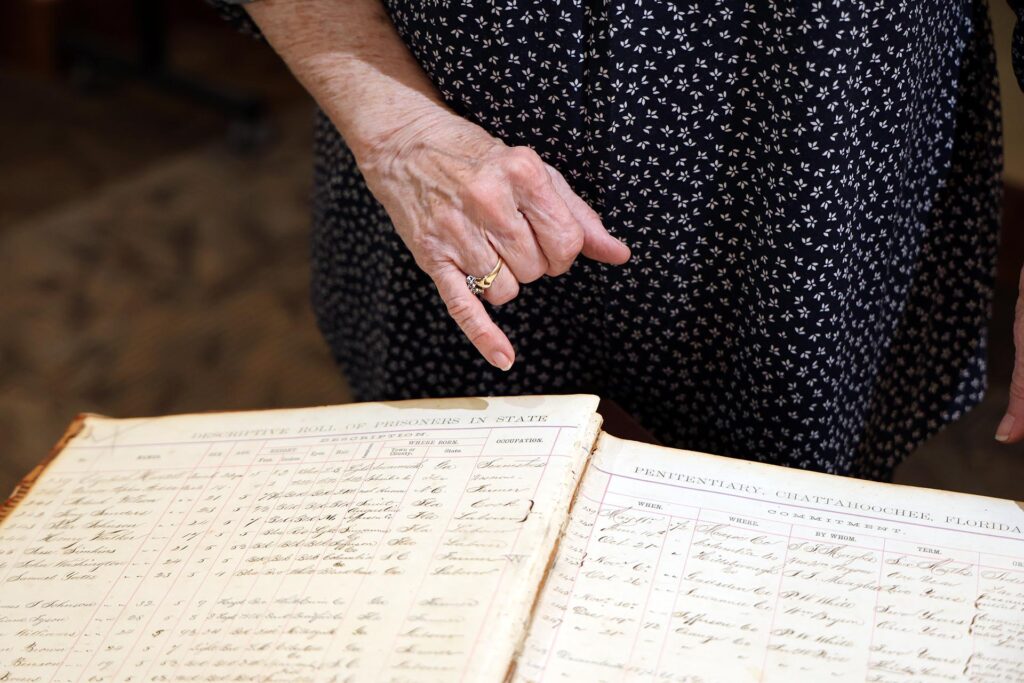
A screen was not always enough, so Linda flipped through books. Sometimes, she recruited experts, such as museum and history professionals, to scan through material to make sure it could be used in the grant. “I don’t just take it upon myself,” Linda says. “It needs to be justified by people that are knowledgeable or more knowledgeable than I am.”
Step three, Linda built a narrative tailored to the person providing the grant.
“You have to write it to the person that’s giving you the grant, and have to know what it is they fund so that you can word your grant to coincide with what they’re looking for,” Linda says.
She wrote her first grant for the arsenal in 1993, which marked the beginning of a restoration effort that would be completed in 2013. Through five more grants, local partnerships and persistence, the building received a long-awaited remodel. The floors were redone with wood, ridding them of the dust, dirt and grass that carpeted the ground. The building was insulated, and with it came an eviction notice for the creatures tucked away in corners and under debris.
The tree that broke through the ceiling was removed, and an artisan restored the brick barrel-vault ceiling to its former glory. The columns, along with much of the other restoration work, were done by Department of Corrections inmates who helped throughout the facility.
2014
While living in Orlando, Linda was invited to the grand reopening of the Apalachicola Arsenal Powder Magazine Museum. Shortly after, she received a call from Marguerite Morgan along with an invitation to lunch in Tallahassee.
The two met at a Chicken Salad Chick restaurant, where Marguerite dropped a two-inch stack of paper on the table, and Linda’s shoulders jumped. She assumed it was hospital paperwork, but Morgan’s intent was clear.
“Finish what you started,” Marguerite told her.
Linda paused at the question. “Finish what I started?”
“Yes, the powder magazine…,” she said.
Linda laughed. She had no intention of commuting from Central Florida. Marguerite assured her she could telecommute. Linda agreed and worked as a volunteer before she received another call.
“You’re working too hard,” Marguerite told her. “I’m going to put you on the payroll.”
Linda was drafted into securing the funding to convert the now-restored arsenal into a time capsule capturing Chattahoochee’s history. After moving to Tallahassee and working 20 hours a week, Linda reacquainted herself with the arsenal’s past.
The arsenal was built in 1834 — the only arsenal in the state of Florida. Only three buildings remain from the original. The brick was made by Benjamin Chairs, one of Florida’s first millionaires, who paved the streets in Jacksonville.
2016
Linda was not alone in transforming the space into a museum. Tristan Harrenstein, a 42-year-old public archeology coordinator for the Florida Public Archeology Network in the North Central Region, contacted Linda near the opening of the Arsenal Museum in 2014.
Tristan walked into his small office building, its historical floorboards creaking with age as odd shapes jut out, evidence of previous renovations. What used to be a tenant farmer building for Alfred B. Maclay Gardens State Park in Tallahassee, Florida, became a base for the Archeology Network where Tristan works. Linda’s passion immediately caught Tristan’s attention a couple of years after the Arsenal Museum’s grand opening. Her energy and drive encouraged Tristan to help her in any way he could, from providing connections and programming ideas to brainstorming donation policies for museum displays.
Tristan says he is often a listening ear as Linda talks through issues and ideas. “Right from the start, I realized that this is someone who’s doing some good work with a really, really cool facility … and I want to support this in any way I can,” Tristan says.
Today
Nowadays, a large part of Linda’s work consists of organizing events in Chattahoochee. She especially enjoys those made for children. Kid-friendly literary events like tea parties themed around Dr. Seuss, “The Secret Garden” or “A Little Princess” are popular. Exhibits also contain elements that involve children, like the food exhibit’s SPAM carving contest.
The museum’s support network extends far beyond the workings of professional historians and archeologists, into the near reaches of the local community. David Pippin, a 56-year-old business owner, sits at the front desk of his service shop, Pippin’s Tire & Auto Services, which was built in 1954 by David’s grandparents as a service station. The sound of customers briefly fills the shop with every bell ringing from the open door. The business’s familiar rhythm has been home to David for more than three decades.
Five minutes down the road from the Apalachicola Arsenal Museum, David has watched the arsenal come back to life. He was responsible for helping deliver one of the key features of Linda’s Native American exhibit, a preserved dugout canoe that was donated from Tallahassee. David, who has U-Haul access through his service station, made the special delivery and has gone on to sponsor events from the museum, including a recent SPAM-carving contest inspired by a traveling food exhibit.
“It’s a hidden gem,” David says of the museum. “It’s off the beaten path, but once you get there, oh my gosh, it’s so wonderful.”
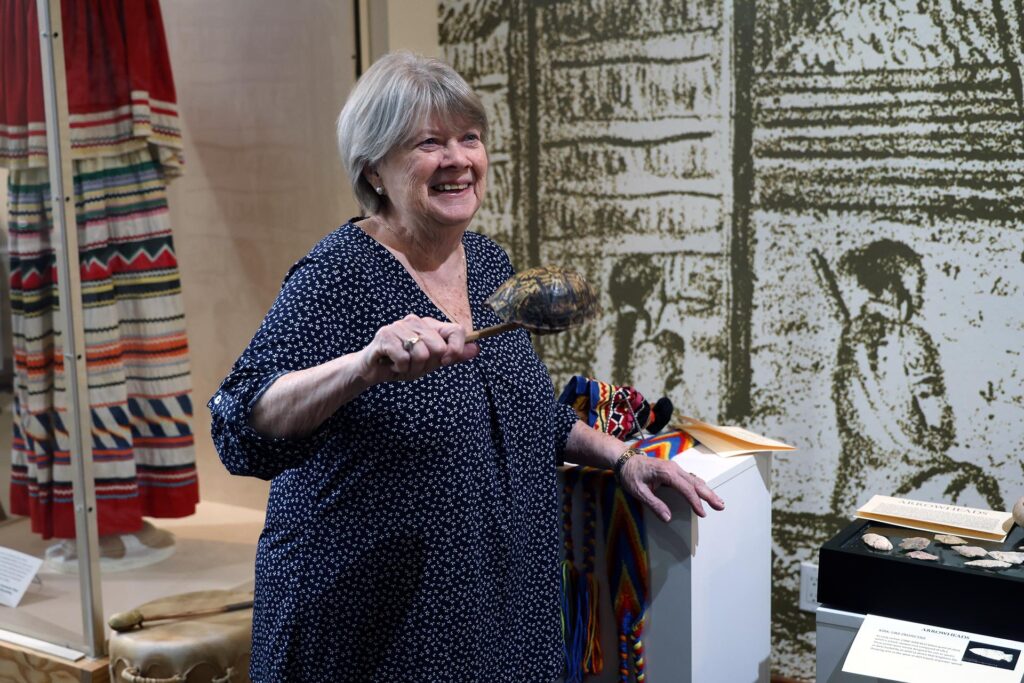
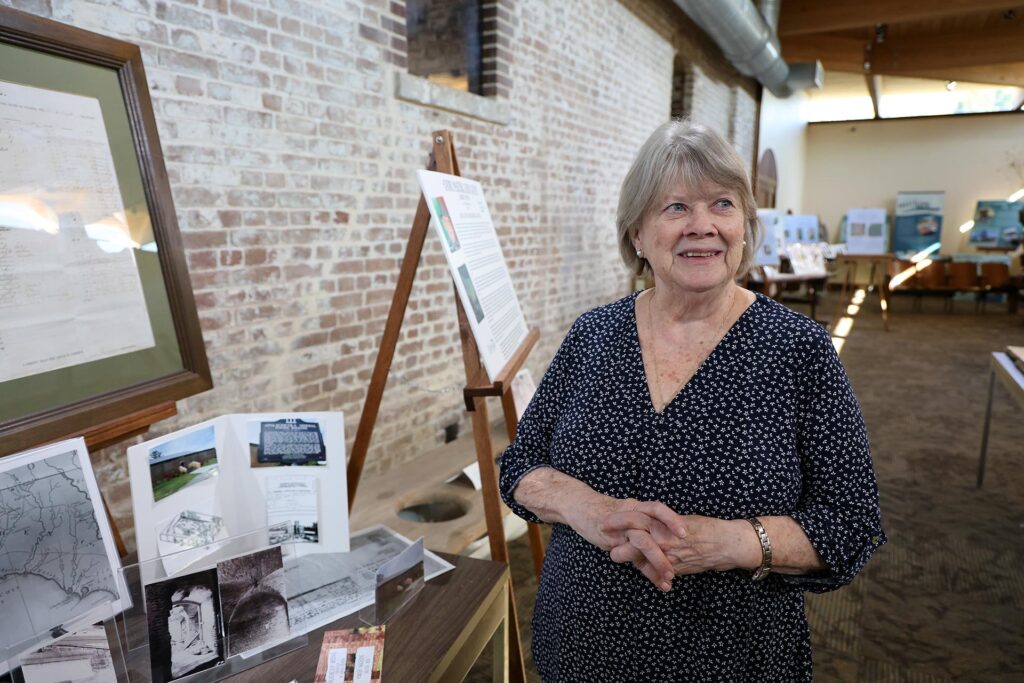
A group visits the museum, and Linda leads them through the various exhibits, showing off her intimate knowledge of every inch and artifact. Her knowledge is vast, from powder magazine remains and hospital relics to Native American artifacts. A member of the group pauses in his tracks momentarily, eyes glued somewhere close to the ceiling.
“There’s grandpa’s name!” he says.
There was a Joe and a C.C. Newberry carved into the brick. It was his grandfather who had worked at the hospital, and the discovered history puts a smile on Linda’s face.
She laughs at the irony that she, a girl from New Jersey, was the one to preserve a Confederate arsenal.
“There are hidden parts of people’s lives that are in there and should be recognized and appreciated,” Linda says. “I kid them all the time and tell them it took a damn Yankee to get them off their butts to save the building.”
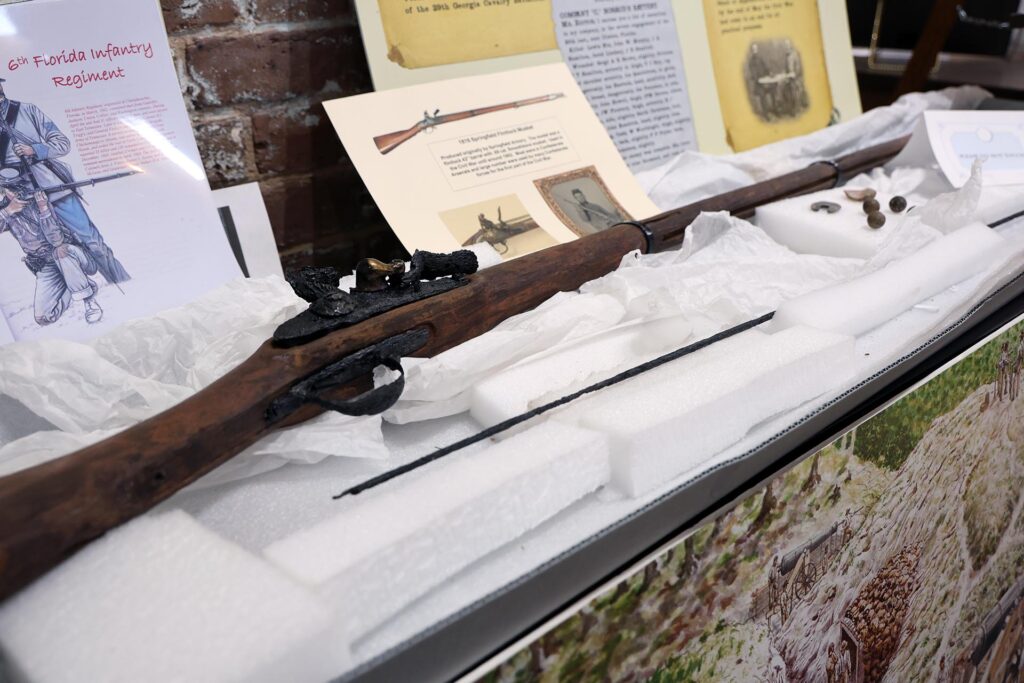
Surrounding the center of the museum, shaped by the arsenal’s rectangular outer walls and a roof installed as part of the original restoration, the museum prides itself on its permanent exhibits. One section focuses on the arsenal and powder magazine itself, detailing the history of the infantry stationed there through writings and relics.
Around the corner, stories of local Native American cultures, such as the Seminole and Creek tribes of the region, are highlighted through canoe remnants, turtle-shell instruments and recreations of traditional clothing. Another section gives a glimpse into the historical interiors of the hospital ground buildings down the road.
From December 2024 to November 2025, Linda’s curated exhibit focuses on the history of cuisine. Sprawled across picnic-cloth tables, Linda displays vintage cookbooks, offers free food samples and showcases antique kitchen tools.
In a nearby room, the Arsenal Museum displays the Smithsonian’s Water/Ways Exhibit, one of the six museums to host the exhibit. It drew over 800 visitors, many from outside Chattahoochee.
Courtney Piper Junçaj, a 31-year-old Florida State University graduate and former intern at the arsenal, worked at the museum between 2018 and 2019 and offered guidance on labeling and arranging exhibits. She remains friends with Linda after her internship tenure.
In the conference area off the right side of the museum, the two worked in tandem. Cookies and snacks would crowd their round table, and a kettle steaming expelled the scent of prepackaged tea bags. The wrappers pile up inside the nearby trash can. The pair spent hours researching, planning new exhibits and reviewing grants.
“She is a spitfire, in the best way possible,” Courtney says of Linda. “That museum is only there because of Linda.”
Linda wishes more young people would take an interest in the museum. Someone from a younger generation with enough passion, she says, could “take it and run with it.”
“Chattahoochee is mostly comprised of elderly people,” Linda says. “It’s a challenge.”
She jokes that the town’s historical society is made up of three active members, not including herself.
Walking through the arsenal today, the vaulted ceilings still create a natural chill in the air. The arches have outlived wars, hurricanes and decades of neglect. Linda lingers by the entrance, the frame of bricks creating a window into the interior.
“It’s a facility that does wonderful things,” she says. “Art therapy … the occupational group … restoring and saving history for me is one of my favorite things.”
