Love, Ed
Over 280 letters hold the story of an Army Air Force soldier who disappeared during World War II
May 8, 2026 | story and photos by Pristine Thai
This story is from Atrium’s Spring 2026 magazine, which released April 2026.
In March 1942, Luther Edward Smith Jr. packed his bags, said goodbye to his parents and shipped off to join the war.
The United States entered World War II three months earlier, and the teenage Jacksonville native figured he’d be drafted. He wanted to have a choice in the matter and hoped to become a pilot. So, he traded his job as a telegraph operator for an Army Air Forces uniform and left home to start military training in Montgomery, Alabama.
To his family and friends, Smith Jr. was just Ed, Bub or Snuffy, a teasing reference to the long-running “Barney Google and Snuffy Smith” comic strip. Ed was only 19 years old when he joined the nearly quarter of a million Floridians who served in the war.
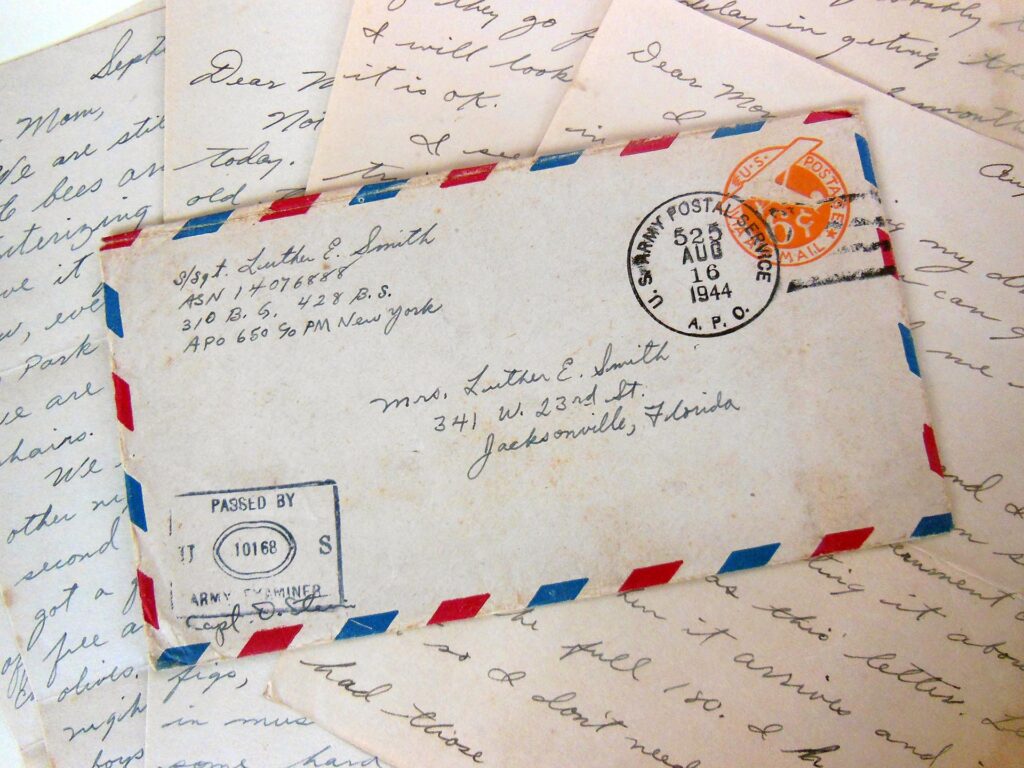
Training moved him from army base to army base across eight different states. In letters to his parents, Luther Edward Smith Sr. and Evelyn Lois Smith, he tried to predict where he’d go next. He ranked prospective camps by how close they were to home. Ocala, Florida, and Douglas, Georgia, were only a few hours’ drive away. Other options like Jackson, Mississippi, or Bennettsville, South Carolina, were much less appealing. Each time he was transferred, he provided his parents with his new mailing address.
“I sure hope you continue to send me a letter each day,” Ed wrote in July 1942 from Maxwell Field in Alabama, “as it does me good to hear from home regularly.”
Ed penned home prolifically about his life during training, sometimes twice a day. He ran miles and miles cross-country, learned to send and receive Morse code, and took classes on everything from radio procedure to mathematics. He’d spend every spare minute at night studying, and he even packed handbooks in his briefcase to read as he waited in line for flight practice.
He wrote about missing his mom’s home-cooked meals. He wrote about his plans to visit Jacksonville on his few days off. He wrote about how he liked being on kitchen duty, even if it meant waking up at 4 a.m., because it was better than standing in parades, which were marching drills so strict he could only move his toes.
After two months of pre-flight school, Ed started primary training in September 1942 and finally went up in the air.
Flying was not as easy as it looked, he wrote during his first week. He succeeded at climbs and descents but struggled to make turns, and it was cold in the open-air cockpit.
“I don’t know if I am ever going to be able to fly one of those things,” he told his parents.
He addressed most of his letters to his mother, Evelyn, although his parents always read them together. In October 1942, his father wrote back.
“Your work is cut out for you; it’s a hard job, but anybody can do an easy job,” Luther Edward Smith Sr. wrote. “No use being just an ordinary anybody doing something just anybody can do. Be a flyer and be a good one.”
Correspondence from home was vital for soldiers, who often went months or years without seeing their loved ones, said George Cressman, a World War II historian at the Camp Blanding Museum in Starke, Florida. Letters connected soldiers to their old lives, giving them an escape from the hardships of war.
“Perhaps the only point of joy and relief that soldiers got was that mail delivery,” Cressman says.
During the war, “No mail, low morale” became the motto of a battalion dedicated to clearing the backlog of undelivered mail and getting it to the front lines.
Beyond serving as a lifeline for war-torn soldiers, letters help historians humanize conflicts. They detail struggles and triumphs not captured by government records, which often reduced individuals to numbers. Cressman calls personal letters “a treasure trove of information.”
“These are key documents in helping us understand what day-to-day life was like,” he says.
As he moved through training, Ed sent home money along with his letters. He asked his parents to use his earnings to buy war bonds and not to send gifts because he was getting by just fine. They sent him sweaters, cigarettes, hard-to-find candy and a new radio anyway.
“Oceans of love to the sweetest sugar in the world,” his mother signed off on a letter to her only child in October 1942.
The Army Air Forces’ needs changed as the war progressed, and Ed was no longer allowed to continue his pilot training. But he knew he belonged in the sky. He’d flown over 200 hours without being airsick once. So, he shifted to being a radio operator and gunner aboard bomber planes.
By April 1944, Ed neared the end of his training and prepared to join the war effort in Europe. He tied up loose ends before he left. He drafted a will just in case, although he doubted he’d ever need it.
He added that, unlike his peers, many of whom were tying the knot before shipping off to the front lines, he had no intentions of “getting mixed up with anyone.” He wanted to wait until his return from overseas to get married. Besides, he wrote, he hadn’t yet met anyone he’d like to marry, not when he spent long and grueling hours at the Columbia Army Air Base.
After completing advanced training in the summer of 1944, Ed was awarded the rank of Staff Sergeant and stopped in Brazil and West Africa on his way to the European theater.
“Right now it’s a battle between me and the mosquitoes,” he wrote, “and I am beginning to think that they are winning.”
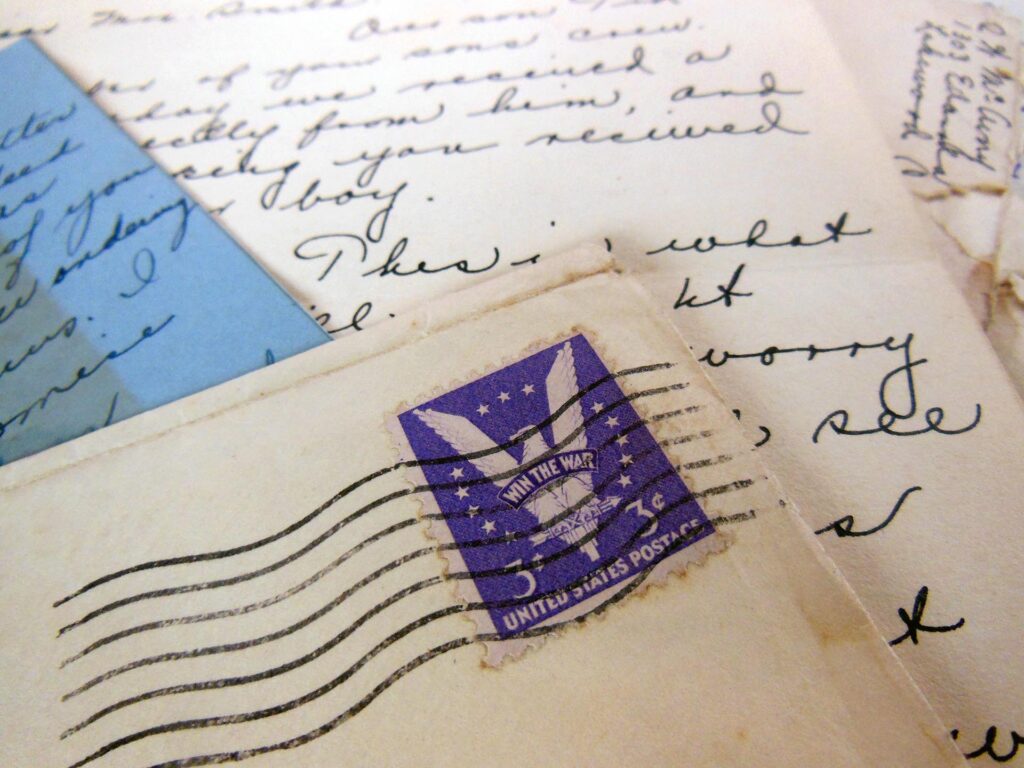
Once he arrived in Corsica, a French island off the west coast of Italy, it got harder to talk about his life in the war zone. Soldiers knew any specific information about their war activities would be redacted by military censors, so they resorted to censoring themselves. Instead, Ed wanted to know how his parents were doing, saying he was anxious to get updates from them when mail came less and less frequently.
He asked them to send small luxuries like cigars, rubber bands, cashews and tins of sardines. Soldiers often requested commonplace items, as scarcity defined the European war theater by August 1944. There were no places to buy anything because there was nothing to sell. Everything Ed received was rationed. Most of all, he missed having fresh milk the way he did when he was home.
He started counting the combat missions he went on. Compared to others in his squadron who had flown as many as 70 missions, he figured he had far to go, but he wasn’t concerned. The missions based out of Corsica were safer, he told his parents, because they had better planes and maintenance.
“There is nothing to worry about,” he wrote on Sept. 7, 1944, “because it is very seldom anyone gets hurt.”
A little over two weeks later, on Sept. 23, Ed was a crew member on a B-25 bomber flying over Altare, Italy. It was the week of his 22nd birthday. At 10:45 a.m., the plane came under enemy fire from the Germans. One of its engines failed, and it started losing altitude. The plane disappeared into the clouds, and Ed was gone.
***
In early October, the War Department sent Ed’s parents a telegram, informing them that their son was missing in action. Preoccupied by the intensity of the war, the military had no details about where Ed could be, leaving his parents clueless about his status — and whether he was even alive.
As the Smiths navigated the grief of their son’s disappearance, condolence letters came flooding in. Everyone, from family friends to the telegraph company Ed worked at before he enlisted, wrote to express their sorrow.
The War Department finally released the names of the five other missing crew members on Ed’s bomber just after Christmas 1944, including the addresses of their next of kin. Evelyn, Ed’s mother, wrote to each of the crew members’ mothers in California, Colorado, Delaware, Indiana and Ohio.
Despite being scattered across the country, the mothers were desperate to share what little they gleaned from second-hand accounts and rumors. They found community in their despair, exchanging photos and news clippings of their sons. They talked about the presumed posthumous medals they had to accept on their sons’ behalf, though their deaths remained unconfirmed. Every time the mothers heard tragic news about the other sons, they said they couldn’t eat or sleep, feeling as if that son was their own.
Months later, the crew’s copilot and bombardier were found alive and returned home. Between the trauma of staying alive and the government prohibitions on sharing unofficial information, neither survivor could offer details on the mothers’ missing sons. Not until a crew member was declared dead could they share what they knew about him.
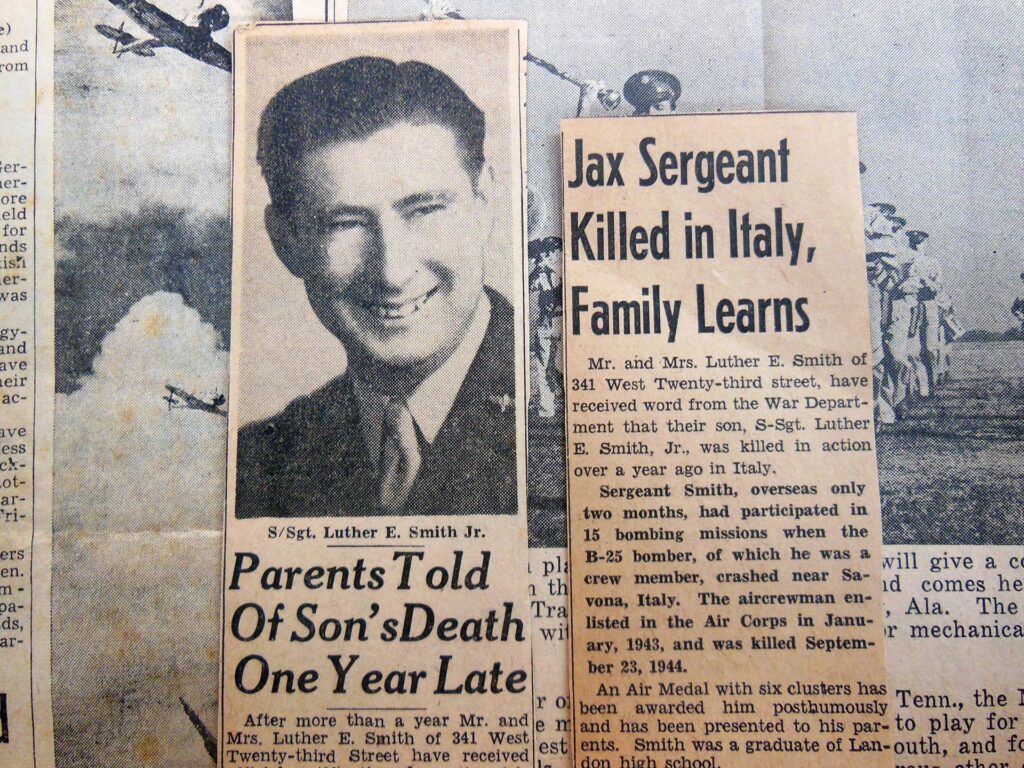
Nearly a year to the date that Ed’s crew went missing, the armorer’s mother finally received confirmation that her son was killed. She was thankful the war was over, but she bitterly resented that American soldiers had been lost to it.
“I guess mothers’ love and prayers and tears cannot protect them against all the evil inventions of civilization,” she wrote.
“I’m so glad this war is over,” wrote another mother just after the V-J Day armistice on Aug. 15, 1945. Her son was still missing. “Glad because of other mothers, that they can be spared of what I’ve gone through. I did not celebrate, like so many others. It was victory for our country, but not for me.”
Shortly after the anniversary of their sons’ disappearance, she and Evelyn were told the War Department had ultimately recorded their sons as being presumed dead. Evelyn was in shock. How could the military presume the death of her only child without telling her everything that was known about what happened to him?
Kurt Piehler, the director of the Institute on World War II and the Human Experience at Florida State University, said families would usually receive their loved one’s death benefits relatively quickly. However, “the government was sort of overwhelmed,” he said, so there wasn’t a real effort to reach out and support families who were grieving.
It was almost worse for the families whose loved ones were missing in action rather than found dead, Piehler added. They often had to delay mourning and funerals for years until they got confirmation of death, if they did at all. Nearly 72,000 World War II service members remain missing today.
Ed was posthumously awarded several medals, including a Purple Heart. It’s unclear when his remains were found and repatriated, but records show he was buried at Arlington National Cemetery in Virginia.
For at least a year after his death confirmation, Evelyn continued to receive letters from people who knew her son. Ed’s best friend had died in another bombing mission the same month. His mother wrote to Evelyn that although she’d never met Ed in person, her son spoke of him “so often that I knew him anyway.”
“He [Ed] has earned his peace — now let him reap his reward,” another one of Ed’s friends wrote. “And if you have time, drop a line to a boy who was once proud to call your son ‘my buddy.’”