The Highwaywoman
A painter carries on the legacy of The Florida Highwaymen and memories of the Sunshine State’s history
March 27, 2026 | story by Tarryn Nichols
photos by Tarryn Nichols and Jack Vincent
Mary Ann Clawson peered through a hole in a wooden crate at migrant workers milling about the Immokalee grove. She pressed her face, hot and sticky-sweet from eating oranges all day, against the bright gap to get a better view. She was no older than 5, and her father was among the men.
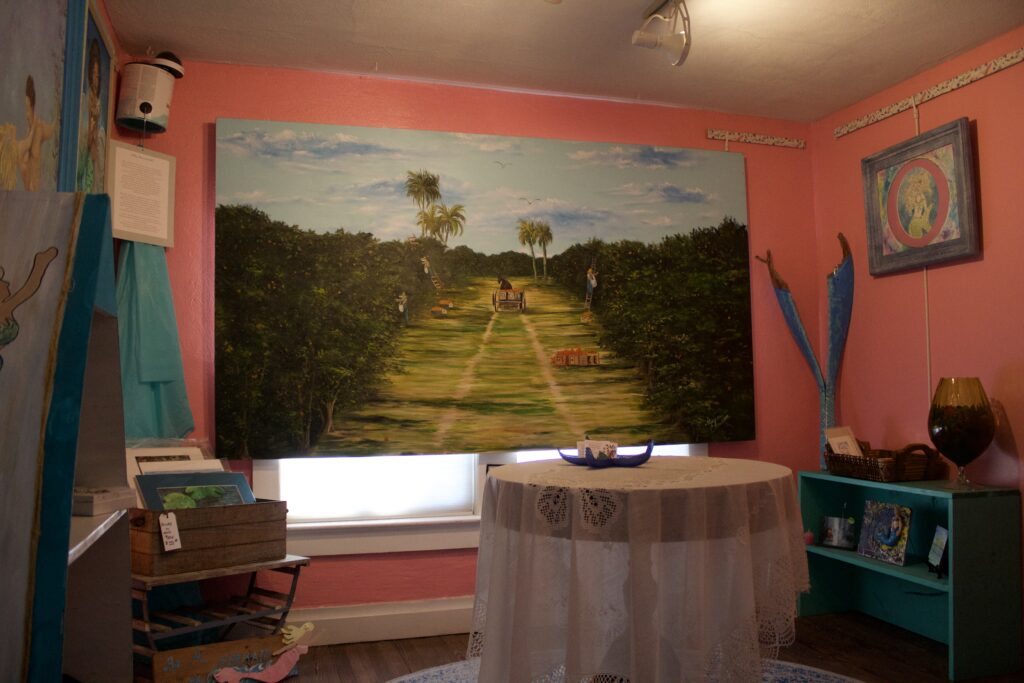
A painting of those orange groves now covers an entire wall in Mossman Hall, a century-old former church, decades later. Other pieces that serve as windows of memory decorate her rented studio on the top floor of the historic building in Melrose, Florida.
A picture of Mary Ann with her arm around Highwaymen painter Al “Blood” Black smiles from a side table. He was the master salesman for a famed troupe of Black artists called the Highwaymen, which emerged in the late 1950s. Black passed away shortly after it was taken.
Of the original 26 Highwaymen, only two remain.
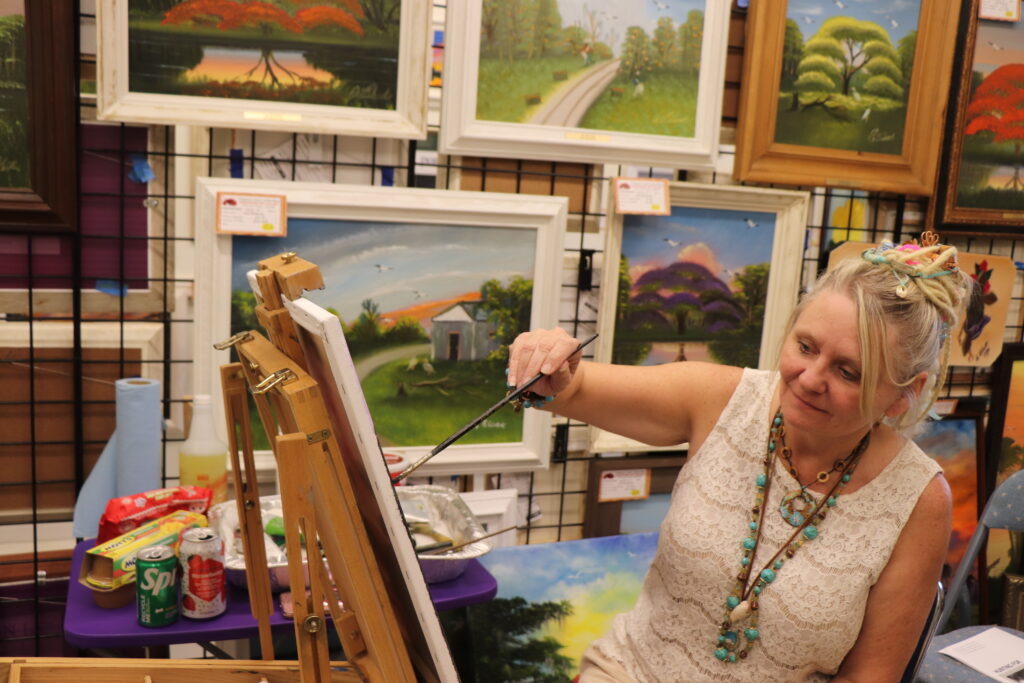
On a September day, Mary Ann was volunteering, like most Mossman Hall artists do, at the nonprofit gallery. She was running a raffle to give away a landscape she would paint that afternoon. Mary Ann, 55, isn’t an original highwayman, but continues the legacy of legendary painters like Black through her paintings of Florida.
“What are you going to paint?” a man asked, who popped in to peruse the oil-painted floor cloths on display.
“I have no idea yet,” Mary Ann said. “It’ll just happen.”
The Florida Highwaymen consisted of 25 men and one woman, Mary Ann Carroll. They were inspired by mentor Albert Ernest “Bean” Backus, a traditional Florida painter with a knack for capturing light in his landscapes.
His protégés rendered swiftly on cheap Upson board, framing their works with crown molding and peddling them around the greater Fort Pierce area while the paint was still wet. By selling unlicensed works for an affordable $25 each, they painted their way out of the orange groves and packinghouses of the 1950s.
Time was money for the Highwaymen. The creation of a new, untethered style and art movement was an unintended byproduct of their haste.
Their name, deemed controversial at first because of the bandit connotation, was coined by curator Jim Fitch of the Museum of Florida Art and Culture (MOFAC) in 1994.
In Gary Monroe’s mid-century modern living room, a large sunset by Highwayman Harold Newton is mounted where a TV might have been. The photographer and art aficionado learned about the troupe over 20 years ago while doing research for his book on self-taught outsider artists in Florida.
He connected with Mary Ann Carroll and “high-tailed” it to Fort Pierce, where he listened to the stories of Carroll and two other Highwaymen.
“Being a native Floridian and having a master’s degree in fine arts, I thought I knew about everything art-related in Florida,” Monroe said. “Suddenly, I realized I didn’t.”
A paragraph turned into a standalone book on the group’s history, “The Highwaymen.” He authenticated the myths and stories shrouding their past, such as the assumption they mostly sold paintings to passing tourists on the highway.
Local businesses, like banks and motels, were their biggest customers. The savvy artists sometimes even bartered paintings for medical attention or cars.
Wind-swept palms, swathes of cumulus clouds and brilliant sunsets defined their visions of the idealized state. Though they didn’t invent the postcard image of Florida, the Highwaymen’s art helped make it stick. Florida was a “dream-state as a promise to be fulfilled” to developers. The Highwaymen aimed to protect paradise in each canvas, untouched and raw in its existence. Mary Ann, who was born in Okeechobee, is a native of the dream-state and picks up her brush in its memory.
After she was adopted at 13, Mary Ann would take her mother’s boat to explore the cypress canopy in Cross Creek and Lochloosa Lake. She floated through Florida’s still waters, observing the beauty of the surrounding trees and birds.
After spending over 25 years in Brunswick, Georgia, she moved back to Florida three years ago to take care of her aging mother and started running her studio, “Painted Planet” out of Mossman Hall.
“I came out to Mossman on First Friday for an art walk,” Mary Ann recalls. “As soon as I walked in, I said, ‘This is it. This is where I’m supposed to be.’”
She paints Florida landscapes from the “quieter time” of her childhood. Patrons who visit Mossman Hall often remark that her style is reminiscent of the Florida Highwaymen’s art.
A couple of years ago, an artist friend asked Mary Ann if she wanted to get lunch with Highwayman Al Black.
“I was like, ‘Absolutely, let’s do it!’” Mary Ann says.
The two met Al Black, and his long-time girlfriend, Desiree, and Mary Ann showed him pictures of her paintings. Impressed, he told her about how he became an artist by fixing the scuff marks on wet oil paintings done by other Highwaymen.
Mary Ann and the “King of the Road” became close friends. He and Desiree would stay at her house some weekends, painting, eating crab boils and telling stories by the fire.
He was the fastest painter Mary Ann ever knew. She absorbed his techniques, and his guidance liberated her style. She stopped sketching before picking up her brush and just “let it happen.”
“Hey, do you have a canvas?” Al asked Mary Ann while staying over one day.
“Well, maybe, what are you going to do with it?” she shot back, surprised at her own nerve.
“I’m going to paint a picture,” he said. “I feel like painting.”
“I have a canvas,” she said. “If you give it to me when you’re done.”
“Okay, you can have it,” he said, smiling. He didn’t give his work to anybody. It’s Mary Ann’s favorite.
Al took Mary Ann on as a disciple.
“You’re a legacy artist,” he said when she had no more to learn from him. He told her to preserve Floridian landscapes for the next generation.
“There’s a part of Florida that is just lost now, except for in a photograph or in a painting or in a memory,” Mary Ann says. “So, that’s what I paint a lot of.”
***
Mary Ann remembers nearly drowning as a young girl when her boat flipped. Her dad dived to save her life.
“You’re no mermaid,” he told her. “You sunk like a bag of rocks.”
Mary Ann’s dad rejected her art as a child, scolding her for wasting time and expensive paper. Instead of stopping, she painted on scrap pieces of two-by-four lumber from a neighboring house under construction.
A prized item she brought when she came into Alice Faye Braddock’s care at 13 was a scrap of two-by-four. On it was a painting of a little girl in a pink dress.
Alice, a Baptist missionary at the time, had just bought a pop-up camper for solo mission trips. Her daughter was married, her son was moving out and she had recently divorced. She received a call asking if she could take custody of Mary Ann, a student in her Sunday school class, for the next six months. After difficulties in her childhood, Mary Ann had become a ward of the state.
“I said, ‘Well, I’ll have to pray about that.’” Alice recalled. “I had all my plans, you know? As soon as I hung up the phone, the Lord said to me out loud, ‘You have no reason not to take that child.’”
She nurtured Mary Ann’s creativity, who would often draw out woodworking patterns for her.
“I think she was born to be an artist,” Alice said.
Mary Ann’s dad visited her studio when she was an adult and apologized for not accepting her art earlier.
“You were just trying to be what you were supposed to be,” he told her.
After her dad passed, Mary Ann painted her first mermaid, a sorrowful self-portrait with hot pink scales. She hasn’t been in a “mermaid mood” lately, but almost every one of Mary Ann’s paintings contains a water source. She’s been attracted to the divine element since she was young.
Mary Ann scratches her initials onto wet paint with a curved fingernail, just as the Highwaymen did. The troupe hung dozens of canvases to work on at once, leaving paintings untitled, undated and unattributed in favor of selling them as fast as possible. She’s learned to paint with the speed of Florida lightning, inspired by Al’s weightless paintbrush. But she still has her own trademarks.
“I always try to put something: a bird, animal, gator,” Mary Ann says, gesturing to a pair of ibises deep in conversation. “It’s becoming kind of my little signature thing.”
Now, Mary Ann is painting a series in black and white. She wants to surprise people by departing from the striking colors she’s known for.
“Don’t think you know who I am,” Mary Ann says. “Because I’m gonna twist it on you.”
On an October night, Melrose residents mingle down blue velvet pews with hands full of Southern barbecue. An event poster on the far Gothic window reads, “Old Florida, New Brushes: Mary Ann Clawson, Florida Legacy Artist.”
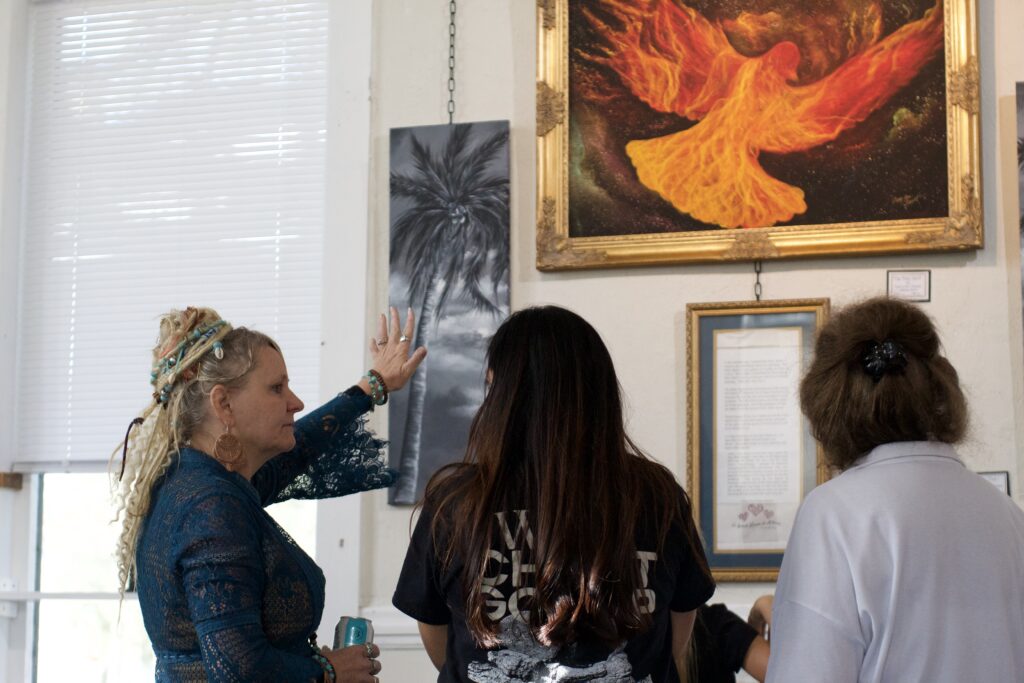
Mary Ann is not hard to pinpoint as she weaves around the room in a deep blue shawl, her blonde hair piled up high with seashells and trinkets like an Everglades mermaid. A treasure chest of jewelry hangs from her neck.
Vivid fantasies of Florida, painted fervently with intense color, are mounted from iron chains, crowding the main hall.
They are all for sale.
At Black’s funeral fish fry in April, Mary Ann discovered her mentor hung only two paintings in his home: her mystical depiction of the Holy Spirit as a fiery dove and a portrait of him in his youth, next to a lion.
A large version of her Holy Spirit painting is on display. It gathers a small throng of people, including her best friend Joan, her husband Sonny and her mother Alice. They peer closely, analyzing the flaming tendrils that wisp into enigmatic figures against a starry backdrop.
Mary Ann says a higher power must have guided her brush.
Joan Nichols, who goes by “Joan of Art,” is a fellow art teacher who befriended Mary Ann in Georgia. Nichols now lives in Darien, Georgia, but drives down to attend every one of her best friend’s shows.
When Nichols was brokenhearted after a divorce, she confided in Mary Ann. Mary Ann comforted her with prayer and hugs and a painting, a “My Girl” portrait of her.
She visualized a specific woman while praying over the portraits and painted whatever came to mind. Many recipients were awestruck, telling Mary Ann that symbols from their own unspoken prayers –– a frog, a red balloon –– had turned up in her “prophetic” portraits. Several “My Girl” paintings hang upstairs in Mary Ann’s studio, the remaining few in a series of over 100 whimsical watercolor women.
The portrait is Joan’s favorite painting by Mary Ann.
“I see every one of these paintings before they go on the wall,” Joan says.
At their home, Sonny Clawson, Mary Ann’s husband, watches as she sets out canvases on the back of their porch and waits for the Holy Spirit to whisper inspiration. The porch overlooks the neighbor’s magnolias, their chicken coop and a gazebo Sonny built. He plays his blues from a surround sound speaker.
“I don’t step on her toes here because this is her thing,” Sonny says. “But if she comes up and says, ‘I need this built, I need this fixed,’ you know I got no problem.”
Alice lives with the couple and enjoys sitting out on their porch while Mary Ann paints. She also comes to every one of her art shows. Resting in an upholstered armchair with a black umbrella tucked between her legs, Alice scans the Mossman masses through bronze-rimmed glasses.
“This is one of the nicest crowds I’ve seen here,” she says.
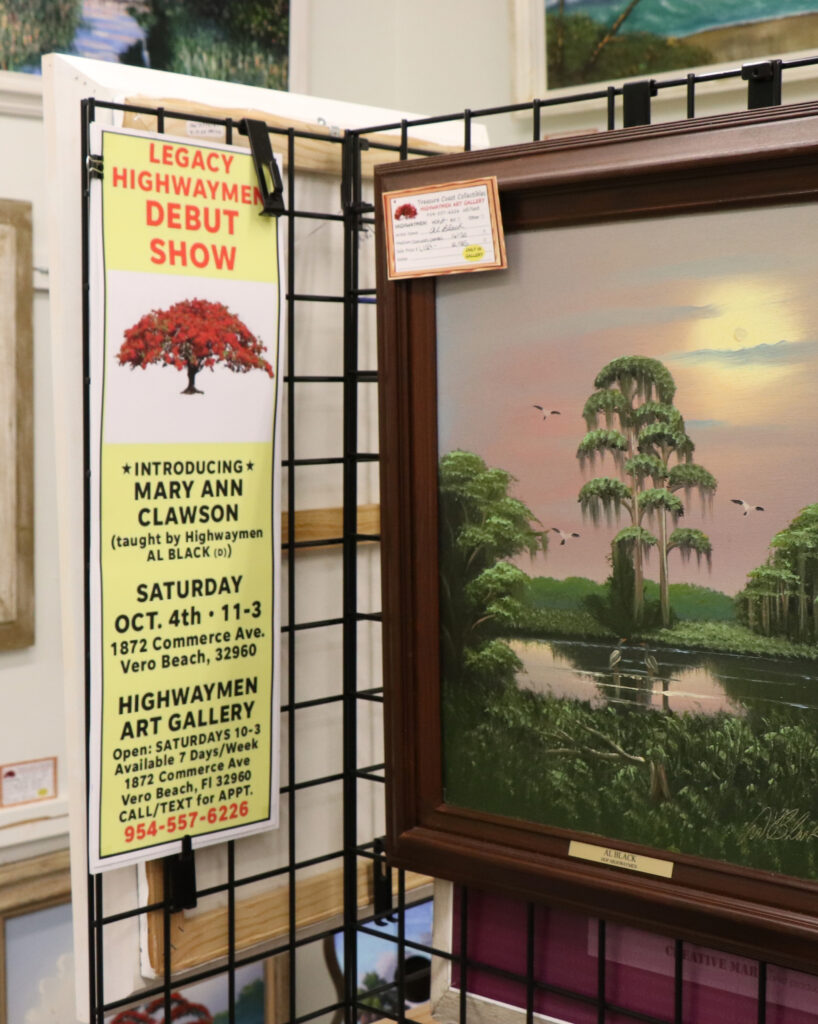
Mary Ann packs some of her paintings in her silver Tacoma after the art walk, ready to hit the highway for another show in Vero Beach. She is set to paint live the following morning. The weather forecast warns of storms and flash flooding, but she holds out hope for a beach trip.
At 11 a.m., she sits down at her easel, hair still braided with beads and shells from the night before. Bold blues, purples and pinks blend seamlessly above a marsh where four white egrets roost.
The show was to go until 3 p.m., but by noon, the oil had already started to dry.
