The crown fit for a champion
How Florida’s largest trees won their accolades, and those who make sure they live to fight another round
(Catalina Martinez-Wittingham/Atrium Magazine)
February 20, 2026 | story by Corey Fiske
photos by Catalina Martinez-Wittingham
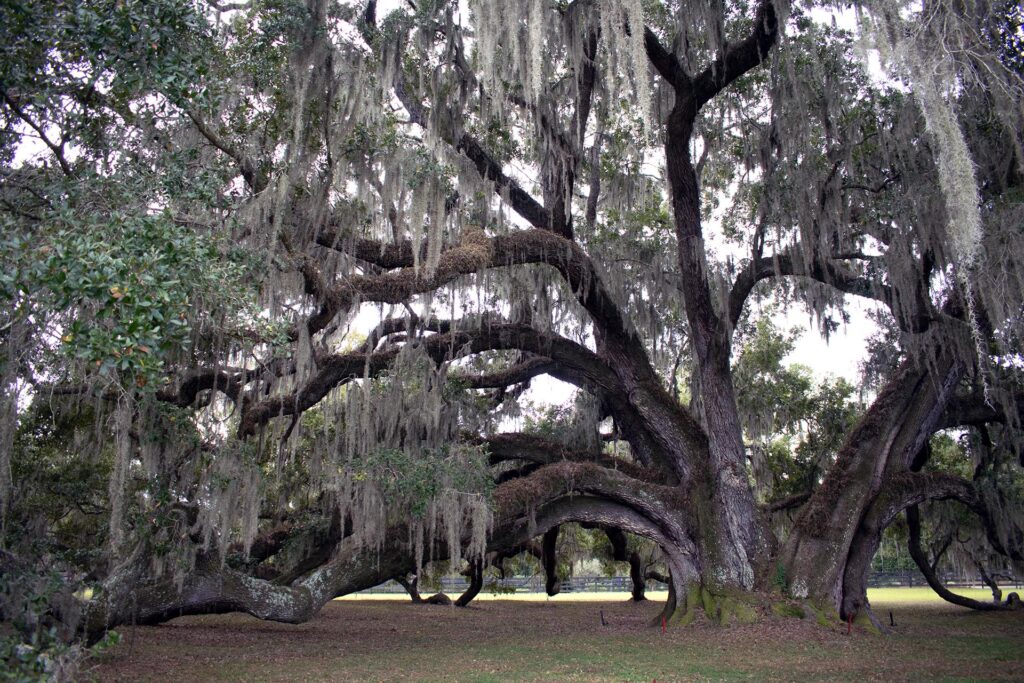
Dave and Liz Wilson never expected to become the caretakers of the largest live oak in Florida. When they retired from North Carolina to an area northwest of Gainesville in 2021, they met Grandpa for the first time. Rising out of the soft, green earth, its rough, twisting trunks swirl north, south, east and west. Branches reach out and dive into the ground before erupting back into the air. Its verdant leaves dance in the sunlight as Spanish moss sways in the wind, hanging like tapestries from the live oak’s old limbs.
The Wilsons’ home sits behind the tree, which they nicknamed Grandpa, far enough away to give it plenty of breathing room. When Dave, 71, and Liz, 67, moved in, they worried about the tree’s health, so they contacted an arborist. Impressed by Grandpa’s size, the arborist told Dave and Liz to get the tree measured. They might have a champion tree on their lawn.
A champion tree is the largest tree of its species, and a winner is determined through height, circumference and crown spread. At the root of every champion tree, there are foresters who care for them, tree tourists who marvel at their size and Floridians who take pride in them. But Floridian champion trees are often challenged by the earth that provides for them. Risks from hurricanes, lightning strikes, fires, age and other trees can take down a champion.
Live Oaks — Alachua County
Grandpa is about six stories tall, and its crown spread is as long as about four school buses parked end to end. It would take about seven people holding hands around the tree to encircle it.
Dave sometimes struggles to maneuver his string mower under the thick, winding branches.
“You need to duck a lot,” he said.
Grandpa might be a champion tree, but it’s also a party host. When the Wilsons’ daughter graduated from medical school, the family set up a sofa and played games under Grandpa’s canopy. In the summer, it can be 10 to 15 degrees cooler under the massive oak, providing a shady reprieve from the scorching Florida heat.
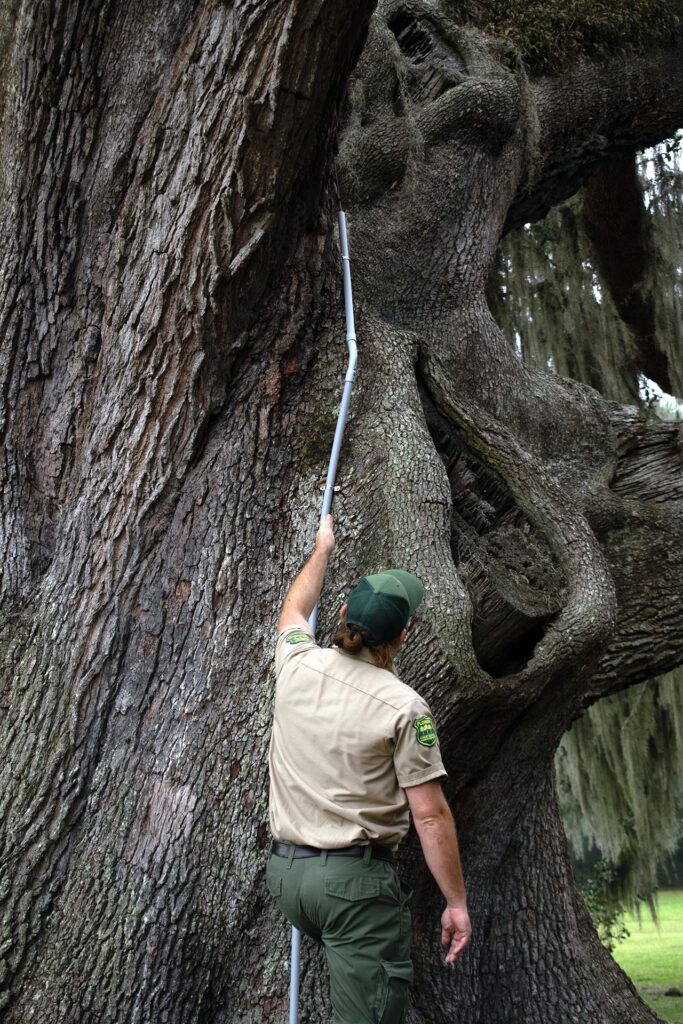
A scar runs along the northern side of the tree from a lightning strike that occurred long before the Wilsons arrived. They worry about the possibility of lightning striking twice, but following the advice of one of the many arborists who have inspected the tree, they chose not to install a lightning rod. It’s best to leave the tree alone as much as possible, the Wilsons said.
The wood near the lightning strike appears gray with small jagged holes, separate from the bark slowly enveloping it. The holes are a sign of termites, tiny pests that can damage even the strongest champions. For now, it’s unlikely the termites will spread into the live part of the tree, Dave said. The living tree will eventually close up around the damaged wood, protecting itself from harm.
The Wilsons worry over Grandpa like it’s a member of their family.
“My wife says we bought a house with a tree attached,” Dave said.
Despite its impressive size, Grandpa shares the title of champion live oak. Cellon Oak, slightly smaller and only 20 minutes away, is considered a co-champion because its total size is within 2% of Grandpa’s, though the measuring process can be subjective.
Ralph W. Cellon Jr., Alachua’s youngest mayor at 26 and an original trustee of Santa Fe Community College, donated the farmland where Cellon Oak has been standing for an estimated 200 years to Alachua County. Now, the tree welcomes visitors for weddings, picnics and family photo shoots, though it usually sits unbothered after Cellon died at 91 in February.
As the forester for Alachua and Putnam Counties, Jesse Frazier is the authority on what constitutes a champion. The role of a county forester is to accept nominations for champion trees and measure the tree to see whether it has earned a title.
“It’s not an incredibly tall tree, but that’s pretty common with live oaks, especially when they’re in an open field,” Frazier said of Cellon Oak, his red hair tucked into a trucker cap.
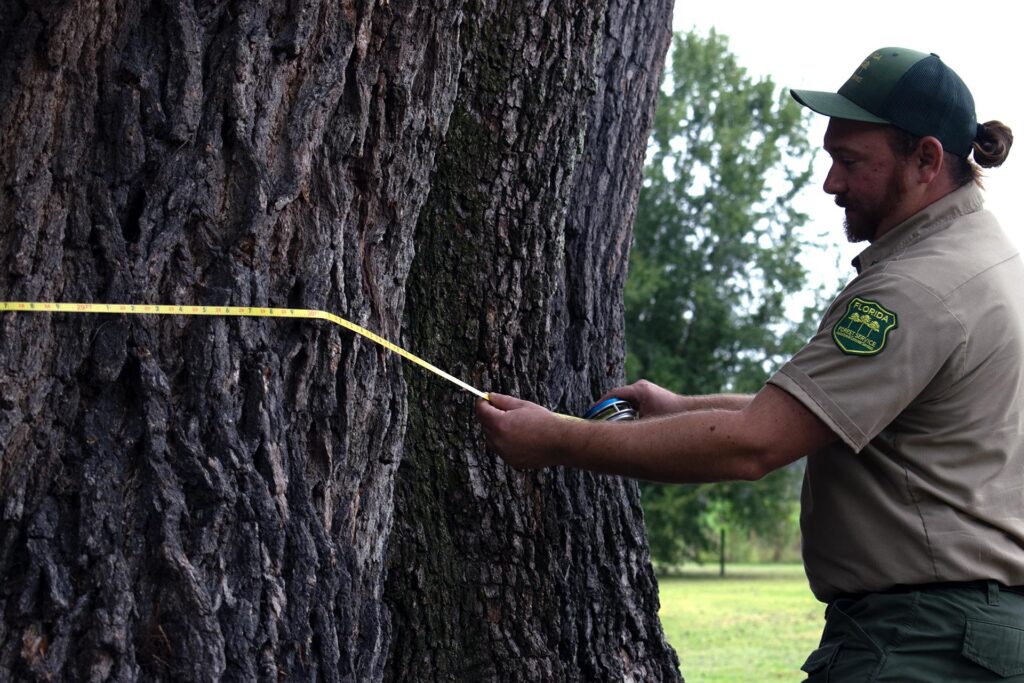
Using a tool similar to a tape measure, Frazier circled Cellon Oak’s fluted base, its folds and curves a hurdle to an accurate measurement of the tree’s circumference. To measure the canopy, he walked two perpendicular lines going from the farthest limb on one side to the other, estimating the canopy’s edge on the ground. The average of the two lines determines the canopy size.
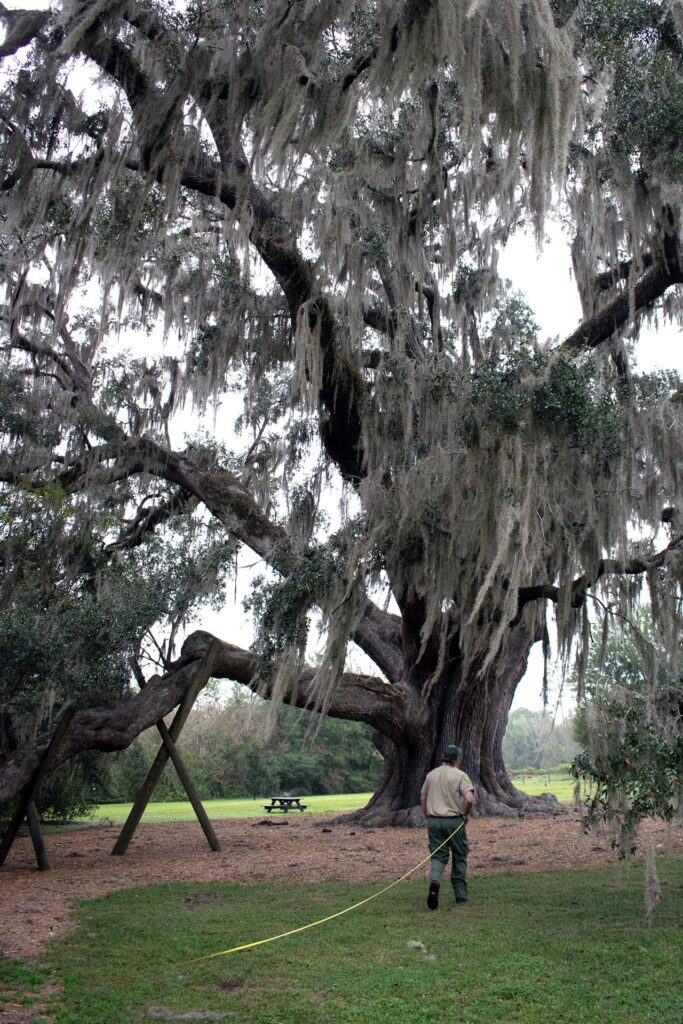
Cellon Oak has also had its fair share of trouble. It’s easy to spot the areas where limbs were sawn off to maintain its health. Like Grandpa, the tree is growing around damaged wood. Some branches are supported by stakes, preventing them from splintering off and offering relief at noticeable pressure points.
Anyone can nominate a tree, though if the tree is on private land, a property owner has to give permission. Frazier has only been on the job since June, so he’s accepted just one nomination — a loblolly bay.
“It doesn’t come that often — it’s not like this is something you do all the time. It’s kind of a unique thing,” he said.
Gumbo Limbo — Islamorada
Jim Duquesnel first noticed a thriving gumbo limbo tree in the Florida Keys in about the 1990s. With flaky, red bark, it’s about three stories tall. Its wide trunk forks into two, then three, directions. Located at the Green Turtle Hammock Nature Preserve in Islamorada, the gumbo limbo sees thousands of visitors a year. While Duquesnel wasn’t the first to see the tree, he was the first to recognize its potential as a champion.
The 70-year-old retired biologist noticed it was large for its species. As part of his job, he visited the preserve every few years and couldn’t get the gumbo limbo off his mind. So Duquesnel reached out to Peter Frezza, Islamorada’s environmental resources manager, who oversees the preserve. The two measured the tree themselves. Then, they nominated it.
The nomination also aimed to make Floridians aware of how unwieldy their landscaping can become.
“For the public, knowing that a gumbo limbo can get as big as this one might influence whether or not they want to put it under the corner of the eave of their house,” Duquesnel said.
Florida began keeping a state register of champion trees in 1975. It’s an offshoot of the national program created in 1940. The largest champion in Florida isn’t necessarily the national champion, but a tree can be both — like the gumbo limbo.
But something else was growing, strangling the life of the new titleholder.
In 2022, Duquesnel and Frezza noticed a pitch apple tree spreading its limbs over the gumbo limbo. The pitch apple tree is an epiphyte; it grows on other plants. A bird likely fluttered over and deposited a seed on the Gumbo Limbo, unaware of its champion title. The seed sprouted roots, becoming its own tree — growing around the gumbo limbo. It climbed up and down the thin red bark, leaving indents on its skin. Duquesnel said the pitch apple was likely outside of its native range, which is the lower Keys and Central America.
Duquesnel and Frezza set off that hot Florida summer with the goal of severing the pitch apple tree from the champion.
They lopped off the top half of the pitch apple, hoping that would kill it. Over the course of two months, Frezza and Duquesnel went out three times to tackle the pitch apple with a handsaw, loppers — long-handed scissors for pruning branches — and herbicide.
“It was like surgery, trying to remove a tumor,” Dusquesnel said.
In October, Frezza noticed a small bit of wood from the pitch apple was left behind. He pulled it out with his bare hands, the final splinter that ended the saga.
Like all great champions, the gumbo limbo is also threatened by the slow march of old age. Gumbo limbo trees only live about 100 years. The tree is close to about 80 years old, according to Frezza, but there isn’t a definitive way to tell.
Loblolly Pine — Amelia Island
The year was 1978, and Tony Lopez and his wife purchased land on Amelia Island to build a new home. They had the land surveyed, and the surveyor told them they had the largest loblolly pine he’d ever seen. Busy constructing their new home, Lopez didn’t get around to calling the forester until five years later.
The forester told him there was a 110-foot pine in Tallahassee and was doubtful Lopez’s tree was a champion. Lopez, who was in his early 30s, measured the circumference of his tree himself. It was wider than the Tallahassee tree. The forester went out the same day to get his own measurements and crowned the loblolly co-champion.
(Catalina Martinez-Wittingham/Atrium Magazine)
“Apparently, it’s a feather in their cap to have a champion tree in their purview,” Lopez said.
It wouldn’t be a co-champion for long. The Tallahassee loblolly pine was struck by lightning in the 1990s, making Lopez’s tree the sole Florida champion.
By 2014, the loblolly also became the national champion. The former national champion in Alabama was also struck by lightning.
Lopez, now 78, hasn’t taken any precautions to protect the loblolly pine from a similar stormy fate.
“That tree has been doing fine without my intervention,” Lopez said. “I hate to let somebody climb that with the [tree climbing] spikes.”
The loblolly pine sits at the bank of a small creek leading to the Intracoastal Waterway. It serves as a final resting place for Lopez’s wife, who died in 2013. Her ashes are buried at the base of the tree in a grotto. The tree still gets visitors, and Lopez’s phone often rings with inquiries, people asking for a chance to see the champion. He’s even had school buses pull up. Tree tourists marvel at its size.
“It has shed some limbs that are bigger than most pine trees,” Lopez said.
The Senator — Longwood
A 165-foot-tall bald cypress near Orlando once claimed the title of national champion. At about 3,500 years old, The Senator had silently sheltered Florida’s Indigenous people for centuries and watched as white settlers claimed the land as their own. It’s named for Florida State Sen. Moses Overstreet, who donated the land it sits on to Seminole County.
In 1925, a hurricane damaged the tree and reduced its height to about 125 feet. By the 21st century, The Senator’s base was hollow, wide enough for a person to climb inside. Students from the University of Central Florida would sneak in after dark to take pictures inside the tree, like a rite of passage.
In 2012, a woman smoked methamphetamine inside The Senator and started a fire, burning the grandiose tree from the inside out. She was sentenced to 30 months in prison.
Bob Hughes was at home when The Senator died, his wife in the living room watching the 10 o’clock news. He walked by the TV three times before he realized what the reporters were talking about. He didn’t know much about the tree, not even its ancient age.
Hughes, a sawmiller, didn’t want to see the tree’s remains go to the landfill. His friend, and the county’s natural lands program manager, Jim Duby, told him it was a total loss. Hughes said it didn’t have to be that way.
“I must have sent him 100 different pictures,” Hughes said. “You know, people carving ducks, people painting ducks, people painting turkeys, people making wind chimes, just a whole bunch of stuff, and I thought, wouldn’t it be wonderful to save this 3,500-year-old tree in an art form.”
Along with two other sawmillers, they made an agreement with Seminole County to take the wood from The Senator and turn it into works of art. They would keep half the art, and the other half would return to the county.
Artisans carved animals like alligators and birds, along with instruments like flutes and items like pens and letter openers.
The county’s half of the art is displayed in the Museum of Seminole County History. There’s a display similar to Stonehenge marking the circumference of The Senator with pieces of its wood.
(Catalina Martinez-Wittingham/Atrium Magazine)
The charred stump of The Senator allowed a new legacy to rise from its ashes. Back in the 1990s, The Senator was cloned by a cypress tree nursery. After it burned down, interest in the experiment grew, and a clone was planted in the same park the next year. In a contest with nearby elementary schools, the new tree was named “The Phoenix.”
When it was planted, The Phoenix was only about 40 feet tall. Maybe one day, it will grow as tall and as old as The Senator — a new generation of champion trees. Like Florida’s other champion trees, someone will be keeping an eye on it.
