From Backyards to Belts
The lives of captured gators in Florida
August 21, 2026 | story Olivia Evans | photos by Delia Rose Sauer
This story is from Atrium’s Spring 2026 magazine, which released April 2026.
As a beaming Florida sun reheats a chilly winter morning, the reptiles at Gatorland Orlando sunbathe throughout the park. Savannah Boan, their platinum blonde leader, struts down the elevated boardwalks in gator skin boots, summoning them as an owner would a puppy.
“Hey, Bungee!” Savannah calls. “Hey, come here.”
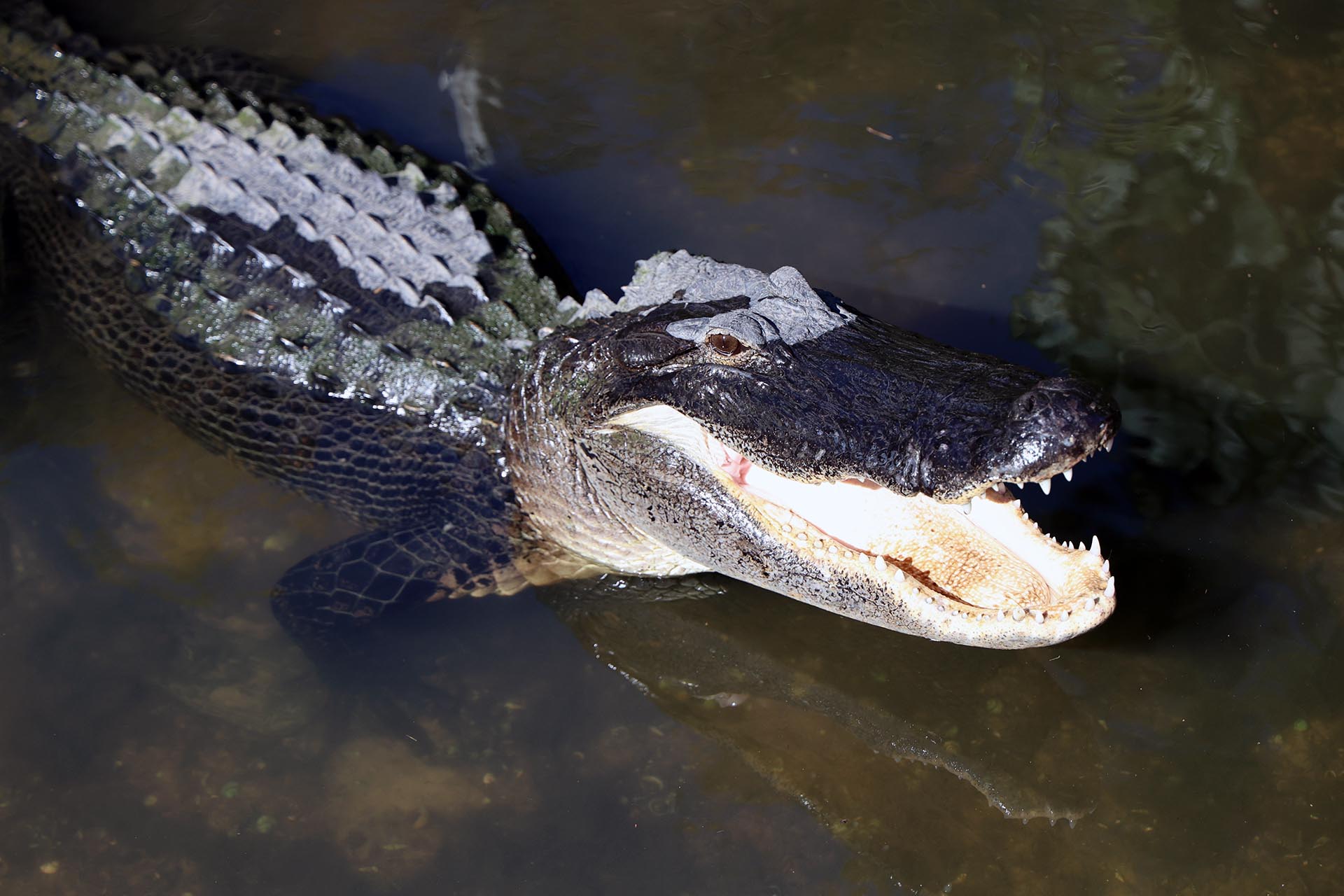
A 9-foot-long American alligator dismounts from his sun spot and waddles through shallow water toward Savannah, turning his massive head as he unhinges his jaw.
“What a cutie. Look at that smile,” Savannah grins.
As Bungee’s pearly teeth gleam, he reveals deep scars on his top jaw — a reminder of his former, less cushy life as a wild alligator in Paynes Prairie Preserve State Park.
Not all Florida alligators end up as lucky as Bungee, fed by conservationists in an enclosure. Wild alligators hear the clanking metal of hooks and harpoons as often as awed gasps. The animals are at the mercy of state regulators, hunters and conservationists who hold conflicting ideas about how to make the animals most profitable.
What was once a simple process of trapping, killing and selling the state reptile has transformed into one of Florida’s most regulated — and contested — wildlife industries. For the alligators caught in the middle, their fates vary from sanctuary to slaughter.
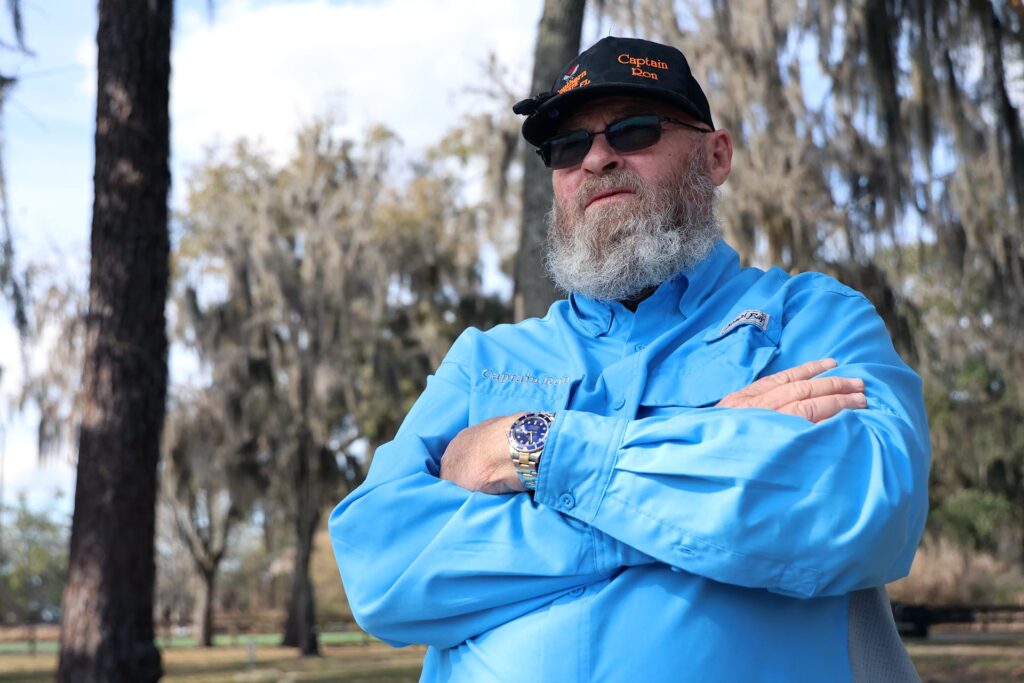
In April 2025, Ron Sanderson was alerted to photos of an alligator living near Paynes Prairie’s busy pier in Gainesville, Florida, circulating on Facebook. Hours later, Kim Titterington called.
“Hey, have you heard about this alligator out at Paynes Prairie?” asked Kim, a reptile rehabilitator known as “Swamp Girl.”
“You know, somebody just called me about it,” Ron said.
“Well, I’m in town,” Kim said. “I’m going to go look.”
Ron, 64, receives calls about alligators almost every day. He’s licensed to trap alligators through Florida’s Statewide Nuisance Alligator Program and caught more than 200 alligators in 2025. Trappers are only allowed to catch alligators deemed a “nuisance” by the Florida Fish and Wildlife Commission, although the line between nuisance and naturally existing is blurred.
Ron had ample experience with nuisance alligators in Paynes Prairie, a preserve overflowing with people who toss scraps at the alligators, unaware it’s a death sentence. Once gators associate humans with food, they lose their instinctive fear of predators. They wander into human paths, and that’s when Ron starts receiving calls. As he puts it, “a fed gator is a dead gator.”
Ron and Kim ventured to meet the alligator dominating their social media feeds. There, they met Bungee, a rope coiled tightly around his top jaw. Despite his impairment, the alligator caught a turtle and ate it with surprising dexterity. Ron figured the rope would eventually wear down and fall off, so they left.
About two months later, the rope never loosened. Calls kept coming, now from Paynes Prairie leadership, reporting Bungee as an official nuisance, accompanied with a permit to catch him. It was go time.
Ron and three other trappers drove along the long, skinny highway splitting Paynes Prairie in half, flanked by marshy land as far as the eye can see. They pulled the truck and pull-behind trailer into a balding grass patch.
He knew Bungee wouldn’t be an easy catch. Standing on a pier suspended above the water, he was too high to reel the alligator into safety.
Although Ron witnessed Bungee gorging on a turtle, he guessed park-goers lacked faith in him and fed him pity picnic scraps. He threw peanut-butter-stuffed pretzels in the water to test his theory, and Bungee bit. Ron threw a rope down, but Bungee — a practiced escape artist — slashed in the water and slid away.
The team returned the next day, armed with treble hooks, or three-pronged hooks that latch onto the alligator’s thick skin. It took three treble hooks, but Ron finally hoisted Bungee from the shallow waters.
They removed the hooks and freed his top jaw. Ron inspected the culprit: not a rope, but a bungee cord cinched so tightly it left half-inch indentations along the alligator’s jaw. It could have cut off his circulation if they had waited longer. The team taped his mouth, and Ron kept a piece of the bungee, which now hangs on the dashboard of his black pickup truck.
The trappers loaded Bungee into the pull-behind trailer, which already held four other alligators caught that day. On the phone, Ron dialed Savannah Boan, a crocodilian enrichment coordinator and handler at Gatorland.
“Do you want it?” Ron asked. “You know he’s under 10 feet, but this is a really cool story.”
Gatorland typically rescues alligators 10 feet and longer, Ron says.
“I’m in,” Savannah said.
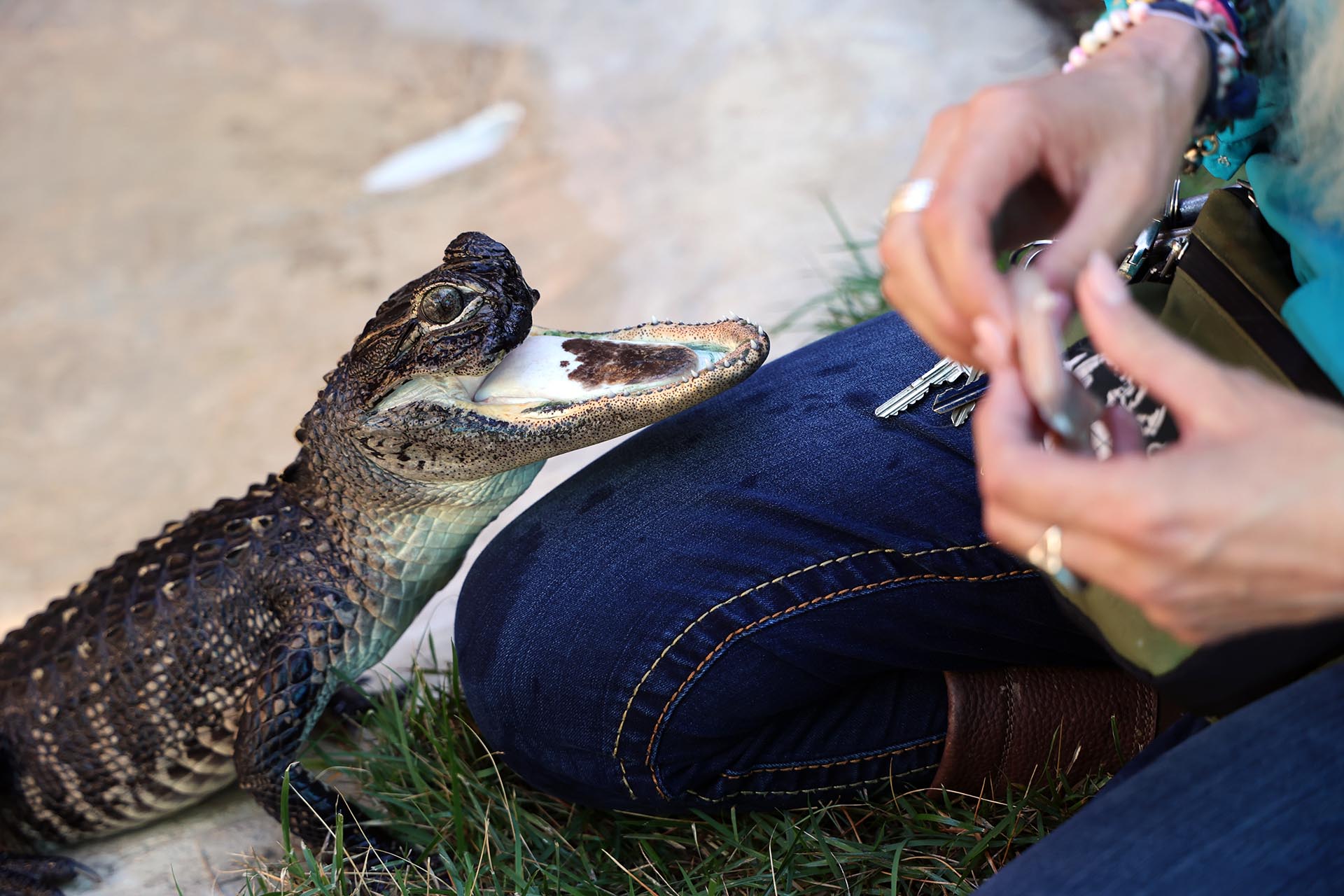
Gatorland doesn’t back down from a challenge. Jawlene, a 4-and-some-change-foot alligator who is missing her top jaw, is one of the park’s shining stars. Known as the “Alligator Capital of the World,” Gatorland is home to more than 2,000 alligators and a highly trained team to care for them all. Ron knew Bungee would be right at home.
Ron met Savannah outside Gatorland, about a 2-hour drive from Bungee’s former home in Alachua County. A team of staff trailed behind her, tasked with filming the transfer for Gatorland’s 800,000 dedicated YouTube subscribers.
They unlocked the hatch of Ron’s trailer. A staff member dragged an eager Bungee out by his tail, placing him on the asphalt. He hurled a hiss through his jaw tape at the team who saved his life.
It took six men and Savannah to corral Bungee. Together, they carried him to the shore of his new home in the ponds of Gatorland, careful to avoid his sharp claws. Savannah straddled his back, and a veterinarian inspected the damage to Bungee’s jaw, concluding it would heal on its own. The team scrubbed him down with a disinfectant and unwrapped the tape from his jaw.
“Alright, Bungee,” Savannah exclaimed. “Go out and get ‘em, man.”
Bungee launched into the water, blending in with the gaggle of alligators if not for his scarred jaw.
In a sea of khaki at Gatorland, Savannah is impossible to miss, with lime-green eyeshadow, swinging pigtails and a voice that echoes across the park. The alligators noticed her within the first week she arrived in 2016.
“When I first started working here, there weren’t any females that were working with the big crocs and alligators,” Savannah recalls. “So they would not acknowledge me at all.”
But Savannah didn’t care. She hadn’t applied to Gatorland for seven years to be discouraged by a little alligator misogyny.
“I talked like a man,” Savannah says. “I lowered my voice, and then they started paying attention.”
Eventually, she spoke in her typical octave as her bonds with the animals grew stronger. Now, she has a litter of pond puppies she can beckon with her call.
Savannah can pick her favorite gators out of the crowd — and so can her loyal YouTube fanbase of more than 800,000 subscribers. Her connection to crocodylia enamors audiences worldwide, with even fans from Germany making a trip in hopes of laying eyes on their favorite alligators beyond the screen.
Some videos feature alligators choosing Savannah’s lunch; others capture thrilling rescue missions scattered with alligator facts. The millions of views she garners funnel dollars that go toward Gatorland Global, the conservation leg of the theme park founded in 2018.
Cuban crocodiles were the first success of the Gatorland Global project. Before Savannah began working for the nonprofit, she flew to Cuba, not a lick of Spanish in her repertoire, to find the endangered species. She roamed through towns on a mission to find anyone who studied the reptile. Now, Ricardo and his girlfriend Chainsaw, two Cuban crocodiles, live at Gatorland. Ricardo is one of Savannah’s favorites.
“I think he’s got one of the best personalities,” Savannah says. “When he used to live in the back … he would come out of the water and hide behind the trees and pop off to the side — a little peekaboo kind of thing.”
As Savannah points to Lyle, the 15-foot Nile crocodile that inhabits an area of the lake no mere alligators dare to venture to, a couple who traveled from Germany in hopes of meeting Savannah and a few of their favorite reptiles ask her for a photo. They had arrived just in time, because as the shutter clicked, the loudspeaker turned on. The Gator Jumparoo was about to begin.
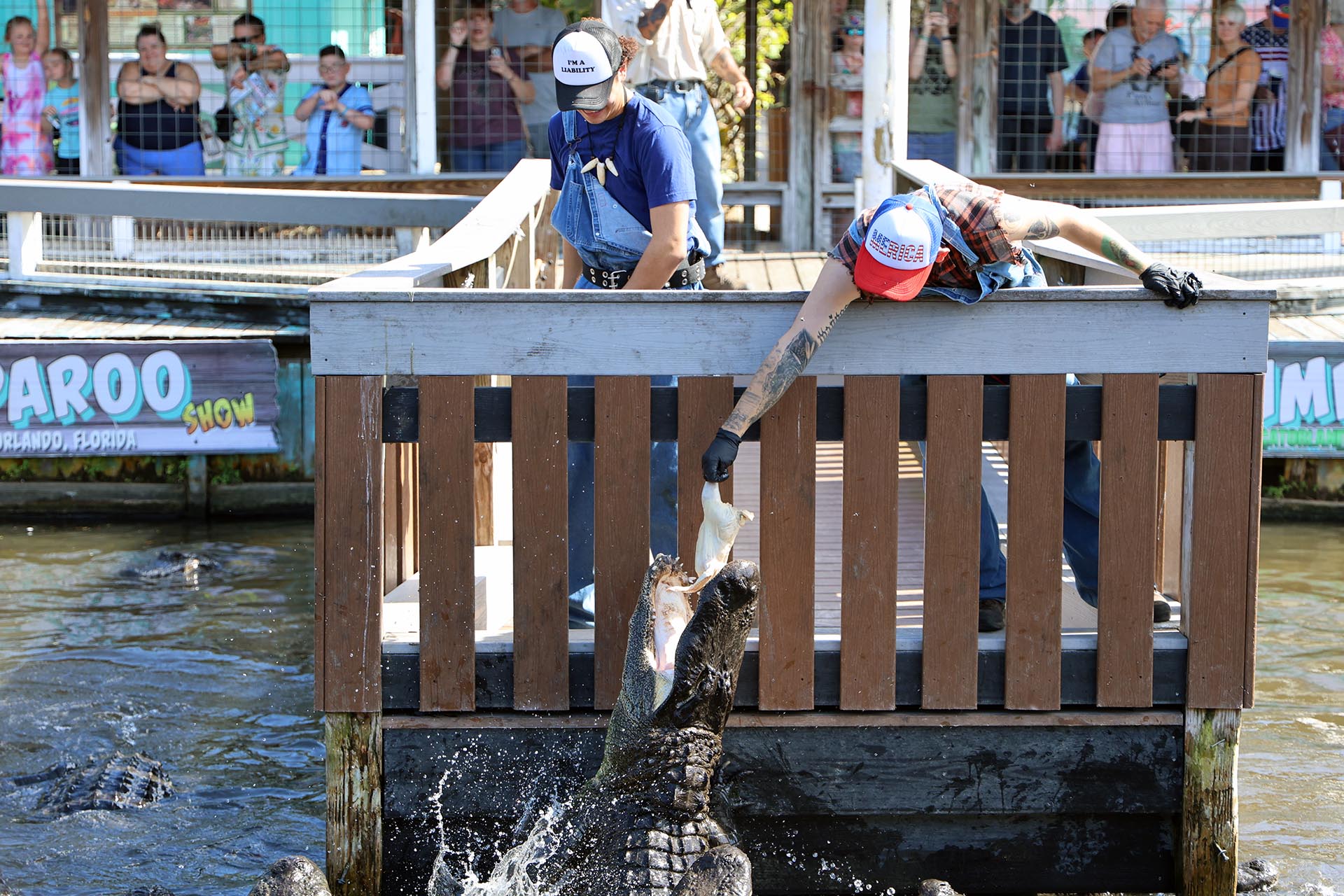
Visitors crowd around the enclosed pond as staff emerge with buckets of raw chicken, dressed in comically Southern attire and sporting even more comically fake Southern accents. They dangle the bait from a platform above the water, and alligators launch into the air to snatch it. Savannah laughs along, but just as quickly, she gently reminds a father that he can’t perch his toddler on his shoulders to watch. Care didn’t just apply to the reptiles.
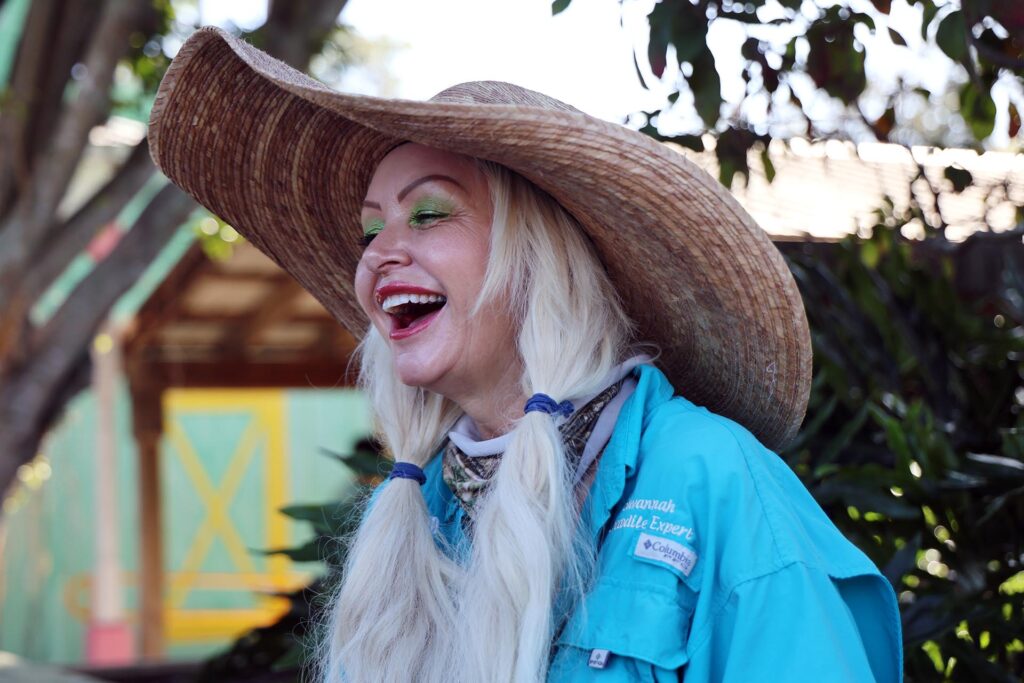
Using alligators for entertainment is not a novel idea. In some parts of Florida, alligator entertainment brings visitors onto airboats, sliding through swamps on the lucky side of a harpoon.
On the drive to Tampa, a towering Confederate flag dominates the sky over the I-4 and I-75 junction. Phil Walters, a 66-year-old member of the Sons of Confederate Veterans, had a hand in raising it. Inside his home, Confederate soldier dolls, a map of the “Confederate States of America” and a poster of “Gone With the Wind” line his walls.
Scattered among the Confederate clutter are relics of Phil’s livelihood: gator skins. Wallets and notebooks sit in plastic bins. Dozens of speckled belts hang on hooks. Rolled-up dyed skins line the shelves.
Phil is a nuisance alligator trapper. He works in Hillsborough County, fulfilling permits and harvesting the skins for his Etsy shop. Phil and Ron met more than 30 years ago, trading tips on how to better trap alligators.
The nuisance trapping business is not lucrative — trappers earn $50 per alligator. With the cost of gas and equipment, excursions can leave trappers in a deficit. They used to sell hides to luxury fashion brands, but when consumer preferences shifted to unscarred leather, alligator farms emerged, where the reptiles are bred in captivity.
“There’s no place to sell alligators,” Phil says. So, he got innovative.
Phil, like Savannah, profits from alligator entertainment. But his money comes from killing them.
During the open alligator hunt season, which lasts August through November, Phil sells spots on his airboat for a hands-on hunting experience. Guided by a professional, his passengers get to kill alligators themselves.
“I’m selling the thing the whole way through,” he says. “I’m the only guy in the business that does that.”
Phil’s hunts are raw and dirty. When he’s out on the water, it’s not playtime. Everyone has to listen to Phil, because it’s a matter of life and death.
The first mishap, he’s nice. The second, he’s loud. The third, he’s Captain Phil. And in his words, no one wants to meet Captain Phil. His hunts attract a wide clientele of thrill-seekers, many lacking any hunting experience, especially not high-stakes alligator hunting.
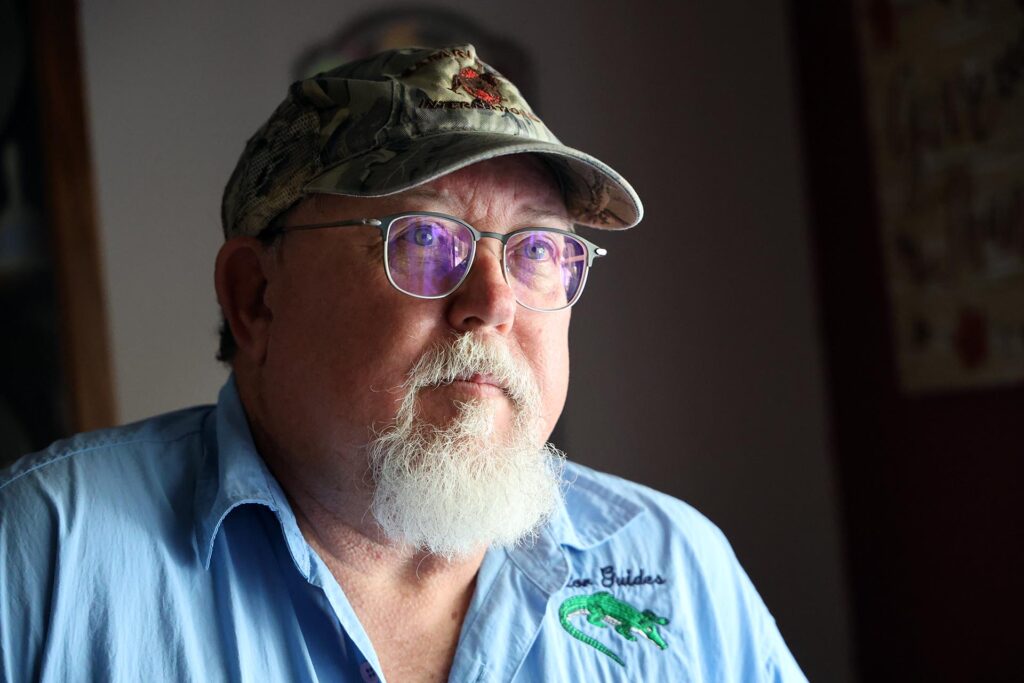
As Phil stands in his upstairs guest room lined with alligator skins, he leans near a taxidermied alligator head — Phil calls it “Dead,” but he actually names his catches after politicians before delivering the final blow, such as “Honest Abe.” The scar on his leg is another artifact of a memorable hunt, one that lives on through animated retellings in bars, each drink destined to add a foot or two to the gator they slaughtered.
It was a few years back when a few men from North Carolina hired Phil to help them seek an impressive catch. The group set out on Phil’s airboat in South Carolina, with GoPros, treble hooks, harpoons and knives at the ready.
After hours on the murky water, the sun turned the passengers into true red necks as they finally spotted a “big ass gator” in the distance.
“Don’t let my wife see this,” one of the men exclaimed. He was a neurosurgeon with hands worth millions, Phil says.
Phil dug for his “swamp people hook” — a treble hook fastened to a rope — and tossed it into the water, wrapping the rope around the alligator. But the 13-foot beast was not going down easily. As Phil struggled, the hook fastened atop its head like a horned weapon, making the already angry animal even more dangerous.
After several minutes of tiring the alligator out, the men managed to get it on the boat. Phil instructed them to sit on it, and in the frenzy, the hook plunged into his calf.
“When he [the alligator] did that, I go ‘poof’ into the lake,” Phil remembers.
As Phil waded in the water, the men scrambled to help, all running to the end of the boat. At that moment, Captain Phil exploded. He wasn’t going to watch these men sink his boat by throwing it off balance.
From the water, he commanded the crew to sit on the alligator and tape its mouth. With the catch secured, he shimmied his way onto the boat. After decades of alligator hunting, this was a first. There was more of his blood in the boat than the alligator’s.
“Get that knife and stick it in,” Phil yelled. “Kill that S.O.B.!”
The alligator died, and Phil was bleeding profusely. Luckily, the surgeon wrote him a prescription on board.
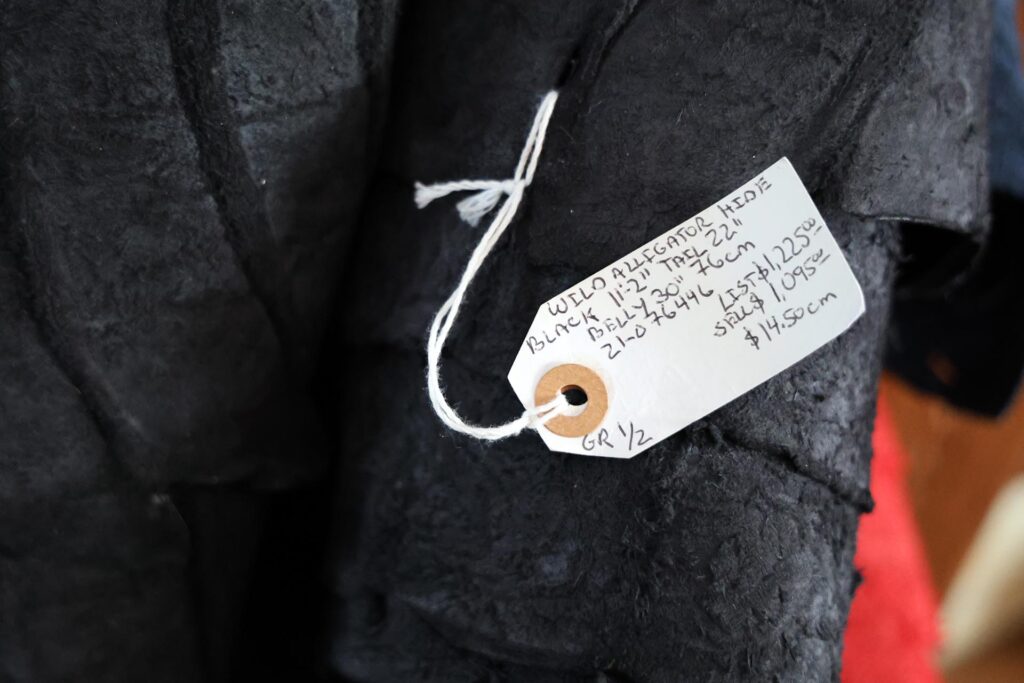
Phil’s hunts draw in a plethora of white-collar professionals who want to try his lifestyle for a day. But they get to walk away, leaving the blood-stained boat and alligator carcass behind. They don’t participate in the endless hours trappers like Phil spend chasing elusive alligators.
The intricacies that exist between a tourist’s spectacle and a trapper’s mundane day-to-day work are where the true alligator business lies.
In an industry where one business decision could mean life or death for an alligator, the struggle between morality and monetization is tricky. For some trappers, the two are unrelated.
“The market is what dictates it,” Ron says. “And there’s nothing moral about it.”
Ron dedicates his life to trapping alligators. As a police officer in the ‘80s, he was trained by the FWC to respond to nuisance calls. After the nuisance alligator program was established, he switched career paths to pursue the reptiles. He used to kill the majority of his catches, selling them to hide and meat processors. Now, it’s more lucrative to hand over the alligators, alive, to farms across Florida. He prefers it anyway — catching a living alligator is more thrilling for him.
When an alligator is deemed a nuisance, there is no path back to the wild. Trappers can’t relocate alligators over 4 feet long, so their options are reduced to sanctuaries, for-profit hunting farms or processing and selling their goods.
What constitutes an alligator as a “nuisance” is a matter of perspective. Jim Darlington, the curator of reptiles at the St. Augustine Alligator Farm Zoological Park, pointed out that humans are invading what was naturally alligator territory. Crocodylia, the order that includes alligators and crocodiles, have been roaming the Earth for more than 80 million years. Humans, or homo sapiens, have only been around for about 300,000 years.
As Florida’s population swells and its waterways attract tourists and developers, people forget alligators are the original Floridians. Ponds alligators once called home become neighborhood swimming spots. When alligators remain in their city-swallowed habitats, residents call for their removal.
For Savannah, education is the key to keeping alligators wild. She teaches her viewers and visitors about alligators’ natural behaviors and the importance of leaving them alone. Education can be the difference between being labeled a nuisance or a natural fauna.
“My heart is always with the alligators in the wildlife,” Savannah said.
As Bungee wades in his shallow pond, hundreds of other alligators swim together in the Breeding Marsh just across the boardwalk. Big Kyle, about a 13-foot American alligator, blind in one eye, dominates the back portion — no one dares to try him, except for Jaws. Jaws is a spunky old alligator, Savannah’s favorite. He’s always trying to fight, but he never wins. He is in a solitary enclosure now — the only one at Gatorland.
They’ve crafted their own pseudo-wild hierarchy, alligators claiming territory and breeding partners and fighting to assure they keep them. But they will never truly be wild again. If they were, Bungee probably wouldn’t be alive. If the cord hadn’t killed him, the other alligators could have sensed his weakness and taken advantage.
Bungee prefers to sunbathe across from the Breeding Marsh, reachable by a short swim under the boardwalk. It’s more secluded there.