Death Row: Paving a new way forward
Since his exoneration from death row, Ralph “Ron” Wright Jr. forges a new identity defined by purpose and second chances.

October 10, 2026 | story Kairi Lowery | photos by Madilyn Gemme
This story is from Atrium’s Spring 2026 collection
Ralph “Ron” Wright Jr. pulls his rental truck into a gravel lot across the street from a Florida prison in Starke, where two security officers stop him.
“I’m here for the vigil,” Ron, 58, tells them.
They wave him through, and he parks in a dirt lot next to the field where about 50 others are sitting in lawn chairs. It’s a cold evening in February and they hug themselves underneath layers of puffer jackets, scarves and blankets. Tucked between their mittened hands are thin pamphlets with printed church hymns.
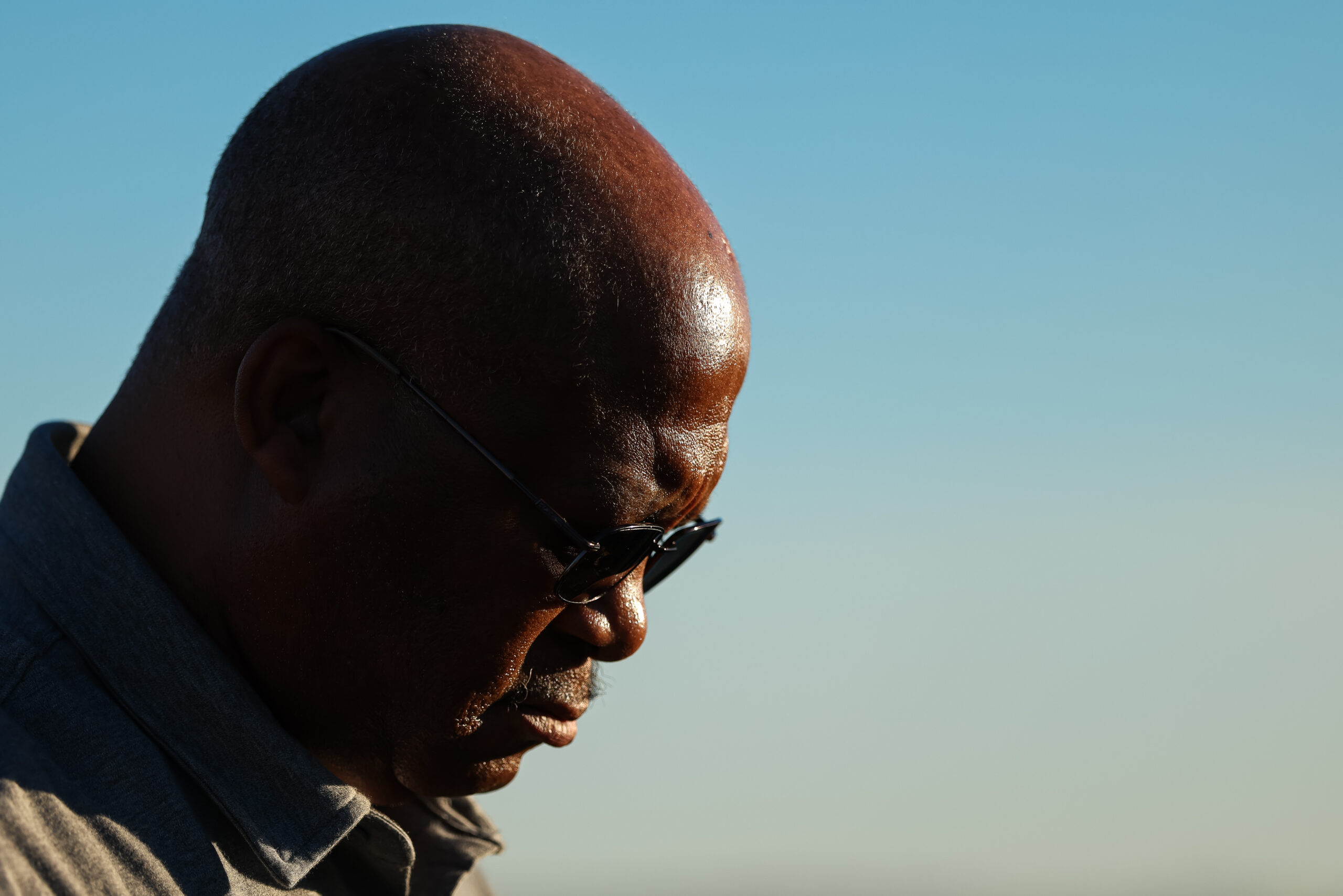
Ron puts his hands in the pockets of his black jacket, bracing against the unusual Florida cold as he hurries to join the crowd. He finds himself gazing past the barbed wire fences toward the jumble of white-bricked buildings.
Ron is one of the last to arrive. His group, Floridians for Alternatives to the Death Penalty, gathers on the short-trimmed green grass to protest the death penalty and pray for Melvin Trotter, a man about to be executed for the murder and robbery of a Manatee County grocery store owner in 1986. It’s the state’s 127th execution.

Just nine years ago, Ron was on the other side of the fence after a jury convicted him of murdering his ex-girlfriend and young son in 2013. In 2025, Florida executed the highest number of prisoners in the nation. The state also leads in the highest number of death row exonerations at 30 exonerees. Ron is included.
Attendees get up from their grey fold-out chairs and form a line behind a black, rusted bell as the vigil begins. Each person rings it, all crying out the same phrase: “Not in my name.” Some attendees’ words amount to screams. It’s a tradition at every execution, and they hope those on death row can hear the bell from inside the prison.
Ron hangs back, his gaze on the prison, unstaggering.
He’s silent, minus the occasional “hello” to a friend or colleague. It’s not a sad silence; he’s deep in thought, remembering what life was like on the inside. The strip searches. The shackles around his wrists and legs. The constant noise reverberating off prison walls.
He remembers it all.
And it never gets easier, no matter how many vigils he attends since his exoneration from death row in 2017.
He approaches the makeshift stage littered with speakers, two wooden stools and black microphones, before looking at the crowd. Few of the faces staring back know he was on the other side of the fence, having been on death row for three years.
He takes one of the microphones and begins his remarks.

The other side
On the first day of his trial in January 2013, Ron sat in court and listened to accounts — and excuses — of why Floridians couldn’t be selected as a jury member for his case. Family emergency here, doctor’s appointment there, he listened to about 120 people do their best to get out of jury duty.
The weight of his situation hadn’t hit him yet.
It all blended together until a woman from New England explained she served on a jury that unanimously convicted a man of homicide and voted to sentence him to death.
His ears perked up.
The woman said the man was executed but was cleared after the actual murderer confessed. She never wanted to make a mistake like that again.
Her revelation made him realize this truly was a matter of life or death.
“I actually felt my stomach sink down to my ankles,” Ron recalls. “I thought to myself, ‘Oh my God, this could actually happen to me. I didn’t kill anybody. I’m not a bad guy.’”
Ron’s trial lasted four grueling weeks, during which state attorneys painted Ron as a deadbeat father trying to continue his “bachelor lifestyle” to avoid paying child support.
They focused on his relationship to the victim, Paula O’Conner, and a black military-style glove found at the scene to prove his guilt. Forensic experts found the same kind of glove issued to his Air Force base in Tampa.
Jurors deliberated for 15 hours. After two days of debate, they confirmed his fears. He was sentenced to death. The judge agreed a year later, solidifying his fate.
For the next five years, he was held in Pinellas County Jail waiting to be transferred to death row.
His wait in limbo gave him time to prove his innocence. Day after day, he sprawled out his case materials and any law-related books he could find, hoping to find any sliver of information that could help his lawyers free him. He studied so much that other inmates started calling him “Mr. Old School.”
Years passed with no success, and he slowly learned the life of a convict.
Wake up before the sun rises. Eat breakfast at 6 a.m. Walk laps in the rec yard after. If it was Sunday, he attended the morning chapel service.
And wait. There was a lot of waiting around in prison.
If he was lucky, Ron got a visit from a family member. He never knew when to expect one.
Learning to adjust was a challenge after spending his whole life on the side of the law as an Eatonville Police Department reserve officer, Orange County Deputy and Air Force sergeant. He was supposed to put criminals away, not be incarcerated as one.
In 2014, it came time for him to be transferred to death row.
Two guards shuffled him past 14 other cells filled with curious inmates before they stopped at No. 15, a 7-by-9-foot cell he would call his home for the foreseeable future.
It was as he expected — a rack with a bed, a metallic sink and a toilet.
With no air conditioning in the prison, his cell was always hot with stagnant, stifling air.
The two guards gave him only one piece of advice.
“You got one guy on one side of you,” the guard said. “Now he’s all right. Can be a little uppity at times, and sometimes he gets a little feisty, but he’s okay. You can talk to him.”
“Interesting that they felt it necessary to share that with me,” he thought.
“That other one on the other side, don’t you listen to a damn word that fool says,” he continued.
And that was it. Ron had to figure out the rest.
He eventually learned the man he wasn’t supposed to listen to was nicknamed “Crash.” When Ron asked why, the man told him his name is like a “crash dummy, because I do dumb shit,” Crash said.
The early days were a blur of new routines. In Pinellas County Jail, he only had one deputy escort him out of his cell. On death row, he was required to undergo a full strip search every time he left his cell; wrist, ankle and stomach shackles; and two guards escorting him.
“It’s a torture that I wouldn’t wish on anybody,” Ron says. “It’s like a perpetual living hell that just gets hotter and hotter.”
For 30 days, Ron was subject to the prison’s “waiting period,” where he was confined to his cell and not allowed to go outside. But he still settled into a routine. Once the month-long period passed, he went outside every Tuesday and Thursday, plugged in his state-provided headphones to his radio and walked laps in the rec yard for his allotted three hours per day.
The state provided inmates with a small television in their cells, too. Ron placed his on top of his metallic sink. He watched cooking shows and Dr. Oz, and when he wanted to feel somewhat self-informed, turned on the Florida Channel at 5 p.m.
He learned how to sleep through the 24/7 sounds of rapping inmates trying to make the world’s newest hit and the constant echoes pulsing off the prison’s walls. Peace and tranquility were rare.
That was life on death row, and he had it down to an exact science.
A Friday evening in 2017 was no different.
He had just finished watching the Florida Channel when he glanced up to see an excerpt from a news story with his name. When he tried to look back to read the details, it was gone.
Then the commotion started, and the surrounding inmates erupted in a mirrored confusion.
“Who Ralph Wright?”
“Anybody know where Ralph Wright is?”
“Man, they did him wrong, man.”
“He better sue.”
Ron was just as lost. What is going on? Amid the chaos, one comment stood out.
“Oh my goodness, that’s Ron, he’s going home.”
Desperate for answers, he asked a nearby officer if he could call his family. His case might have been reversed, he told him. A spur-of-the-moment phone call would normally be a big ask, but because the officer said he was a model inmate, it was OK.
He called Sharon Wright, his sister. “Did you hear?” She blurted out.
“I think I did, but I’m not sure,” he said.
With three words, she confirmed his suspicions: “You’re coming home.”
“It took all of me to fight back all the tears and to not burst out crying,” Ron remembers.
The road to freedom
The Florida Supreme Court issued an opinion a few days before Ron’s call with his sister, concluding there was insufficient evidence to sustain his conviction.
All of a sudden, Ron was a free man. Sharon came to get him on the day he was released. He traded his state-issued orange uniform for a pair of what he called “street clothes,” a pair of jeans and a T-shirt.
The prison’s assistant warden and a few other officers escorted him out, carrying cardboard boxes packed with personal belongings and study materials. Before letting him go, they apologized on behalf of the state for his wrongful incarceration.
The biggest problem with the death penalty is unanimity, said Grace Hanna, executive director of Floridians for Alternatives to the Death Penalty.
In Ron’s case, jurors voted 7-5 to recommend the death sentence. Just a few years after his trial in 2013, the Florida Supreme Court ruled that every death penalty case required a unanimous decision from jurors in 2017.
The ruling was overturned by Gov. Ron DeSantis in 2023 after a jury could not unanimously decide to sentence Parkland school shooter Nikolas Cruz to execution. Cruz received a life sentence instead.
She said the overturned ruling only makes it more likely more people will be wrongfully sentenced to execution.
“Nearly all of our 30 exonerees in the state were sentenced to death by non-unanimous juries,” Grace says. “It means that we will sentence the wrong person to death more often.”

Driving through the backroads of Starke, Sharon’s phone was ringing off the hook with family and friends asking about Ron.
“Did you get him?”
“Is he out?”
“I think after about the third call, driving down the road, somebody called, and I just broke down,” Ron says. “I was crying like a little girl.”
In a lull of tears and conversation, Sharon told him about Floridians for Alternatives to the Death Penalty (FADP), a nonprofit organization seeking to work towards alternative measures to executions.
She was in contact with the executive director, Mark Elliott, and suggested Ron speak to him.
He was hesitant but gave in a few months later with help and encouragement from his sister.
Mark and Ron started drafting plans to address capital punishment in the state, and a few years later, he joined the nonprofit’s board.
He began speaking at executions, like Melvin Trotter’s, and carved his life around advocacy.
His newfound calling led him to his wife, Debra Milke. They met through another organization, Witness to Innocence, which is composed solely of death row exonerees.
The nonprofit group holds a conference every year for its members. Ron attended the conference in Phoenix, Arizona, a year after his exoneration in 2018 and shared his story with a group of about 20 fellow exonerees.
Debra, who had been on Arizona’s death row for over 20 years, was in pure shock.
“When he told us his story about being in the military and being an ex cop, our jaws dropped,” Debra says. “Ron’s story was like, wow, this really can happen to anybody.”
The two went their separate ways until 2021, when they started keeping in constant touch. For their first official date, Ron took her on a helicopter ride over Orlando, his hometown.
Debra and Ron understood each other in a way no one else could. As a fellow exoneree, Ron knew how she felt without even speaking.
Once, she jokingly told her friends she thought the perfect man for her would be a truck driver, because it would allow her to keep her time alone — something she grew comfortable with while incarcerated.
After his exoneration, Ron became a truck equipment driver for big –– and small –– name artists.
Coming out of prison, he didn’t want to go back to law enforcement. In 2019, he learned about an entertainment transportation company based in Iowa.
One application later, he was on the road driving a blue Volvo semitruck hauling stage equipment. He rarely listens to music. He hears what he needs to live. He listens to talk radio instead, eager to catch up on what he missed out on for eight years.
One of his first stops was in Raleigh, North Carolina. Hootie & the Blowfish, an alternative pop-rock band, had Canadian rock band Barenaked Ladies as a special guest opener. Ron was outside his truck basking in the summertime afternoon weather when he spotted the opener’s lead singer, Ed Robertson, bidding some friends goodbye after his opening act.
“Hey man, looking for something?” Ron asked.
It was unusual for a high-profile artist to be without security, even in the daylight.
“I had some friends come out with us, and I was just saying goodbye to ‘em,” Robertson said.
“OK, I just want to make sure everything’s cool, because you know you’re about to get swarmed with people who recognize you,” he replied.
He asked Ron if he wanted a photo, and they snapped one together. It later became his Life360 profile photo.
In his nine years on the job, he’s bonded with Alabama’s lead singer Randy Owen and his wife. He shared breakfast with Kix Brooks of Brooks & Dunn, and even met the “Godmother of Country” Loretta Lynn at her Western Tennessee ranch before she died. The latter was one of the more freak-out moments of the job so far.
“It’s just been amazing being out here, meeting these people,” Ron says.
He’s been on tour with big names like Rod Stewart, Jason Aldean, Luke Bryan, Scotty McReery and Rascal Flatts. Sometimes he fills in for truck drivers, hauling equipment for just a few concert locations. Scotty McReery’s tour was by far his favorite, having spent five years with him.
Seven years and thousands of miles later, he’s still rolling steadily while advocating against executions from the road.
He attends FADP meetings virtually on Zoom, with his colleagues always asking what state he’s in as he drives. They know he’s always somewhere new.
Now, he’s on the road with Styx and Cheap Trick — a switchup from the country bands he is used to traveling with.
Another execution
Microphone in hand on the small stage in Starke, Ron’s voice echoes as he asks, “What purpose does this man’s death serve?”
There’s no response from the crowd.
“Am I to be safer today than I was yesterday, or will I be more safe tomorrow than I was today?” He continues. “What are we accomplishing by executing someone?”
A few heads nod in agreement.
“I could be here and speak to the end of the year about my little three years on that row over there that I know good and well people who have never set foot in there wouldn’t have a clue about,” Ron says, his voice steady and bold. “It’s time we start learning, so we can evolve.”
His remarks don’t last more than a few minutes. They don’t need to. The weight of his experience speaks for itself.
When he finishes, it’s 6:02 p.m. — two minutes after Trotter was set to be executed by lethal injection. A few minutes before, a bald eagle flew by. Some took it as a sign from God; others just as a sign that their work mattered.

A hush falls over the crowd as they take a moment of silence for the man just put to death.
One minute goes by. Then two. Then three.
Tunes of “Amazing Grace” start floating through the air. One man holds a candle in front of a photo of Our Lady of Guadalupe, shielding its flame from the wind. A few wipe their eyes free of tears.
As the song concludes, the crowd knows another execution has come and gone.
While Ron hadn’t known any of the men executed previously, in April, that changed.
The state executed Chadwick Willacy on April 21. Willacy was a few cells down from Ron on death row and has been there for over 35 years.
He hopes that one day, there will come a day when he won’t ever have to gather to mourn the men executed again — whether he knew them from his time on death row or not.